Map responsibilities to the SDLC
Give planning, implementation, validation and deployment distinct responsibilities and control points.
Separate the stages
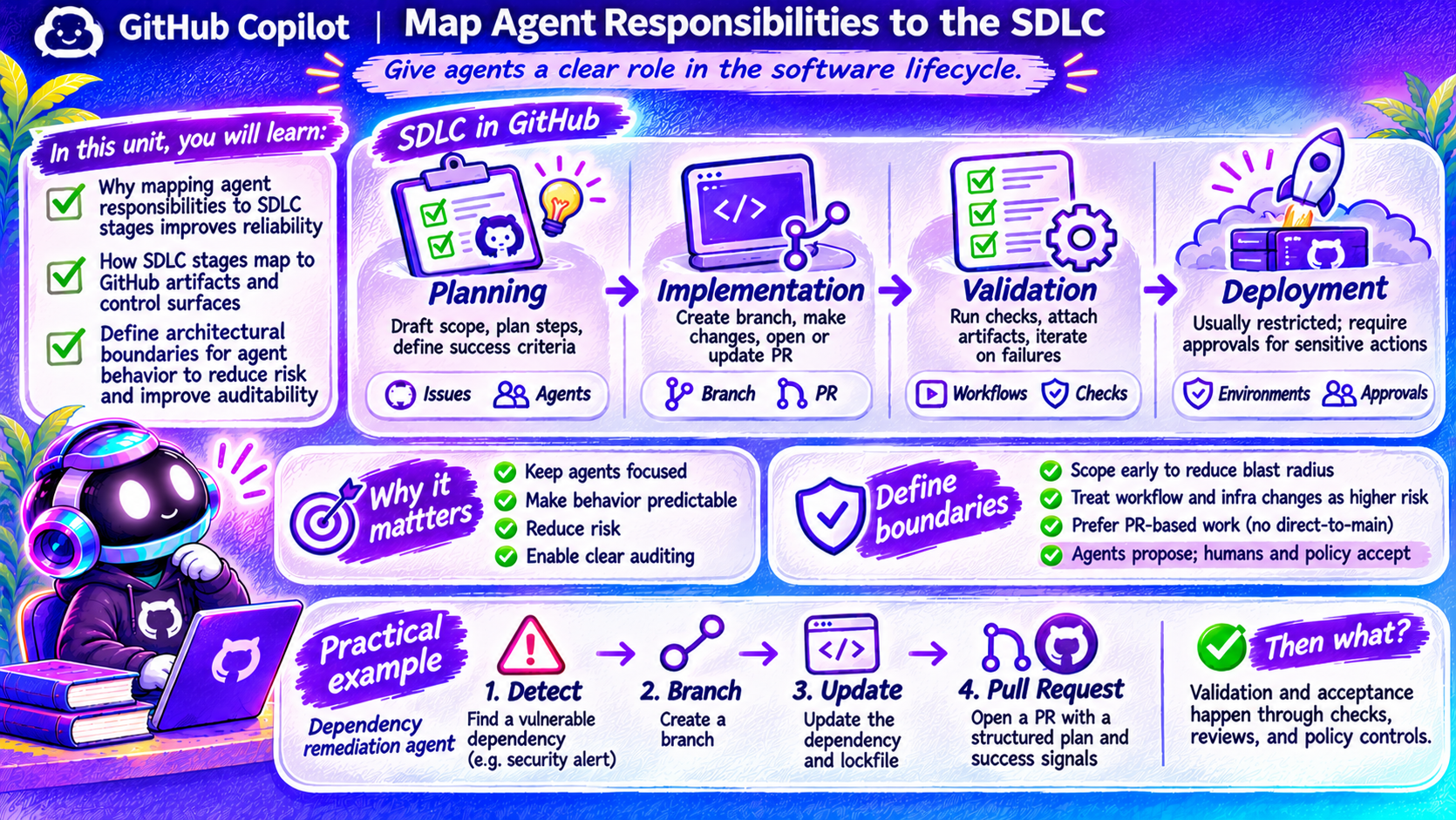
Planning produces scope, steps and success criteria. Implementation changes code on a working branch. Validation runs checks and records evidence. Deployment releases an approved result into an environment.
The infographic maps those stages to issues, branches, pull requests, workflows and environment approvals. Make the mapping explicit for your repository rather than letting one broad agent own every decision.
Define boundaries early
Limit files, tools and credentials for the task. Treat workflow and infrastructure changes as higher risk. A recommended governance model is that agents propose and configured policy plus authorized people accept.
That model is a design choice to enforce, not a claim that every agent inherently lacks merge or deployment capability.
Example: dependency remediation
Identify the affected dependency, prepare a bounded update, include lockfile changes and open a reviewable proposal. Validate that the vulnerability is resolved and that behavior still works. Record residual risks and require the appropriate acceptance controls before release.