Match autonomy to risk
Extend pull-request governance with explicit approval boundaries and risk-sensitive decisions.
From controls to operating decisions
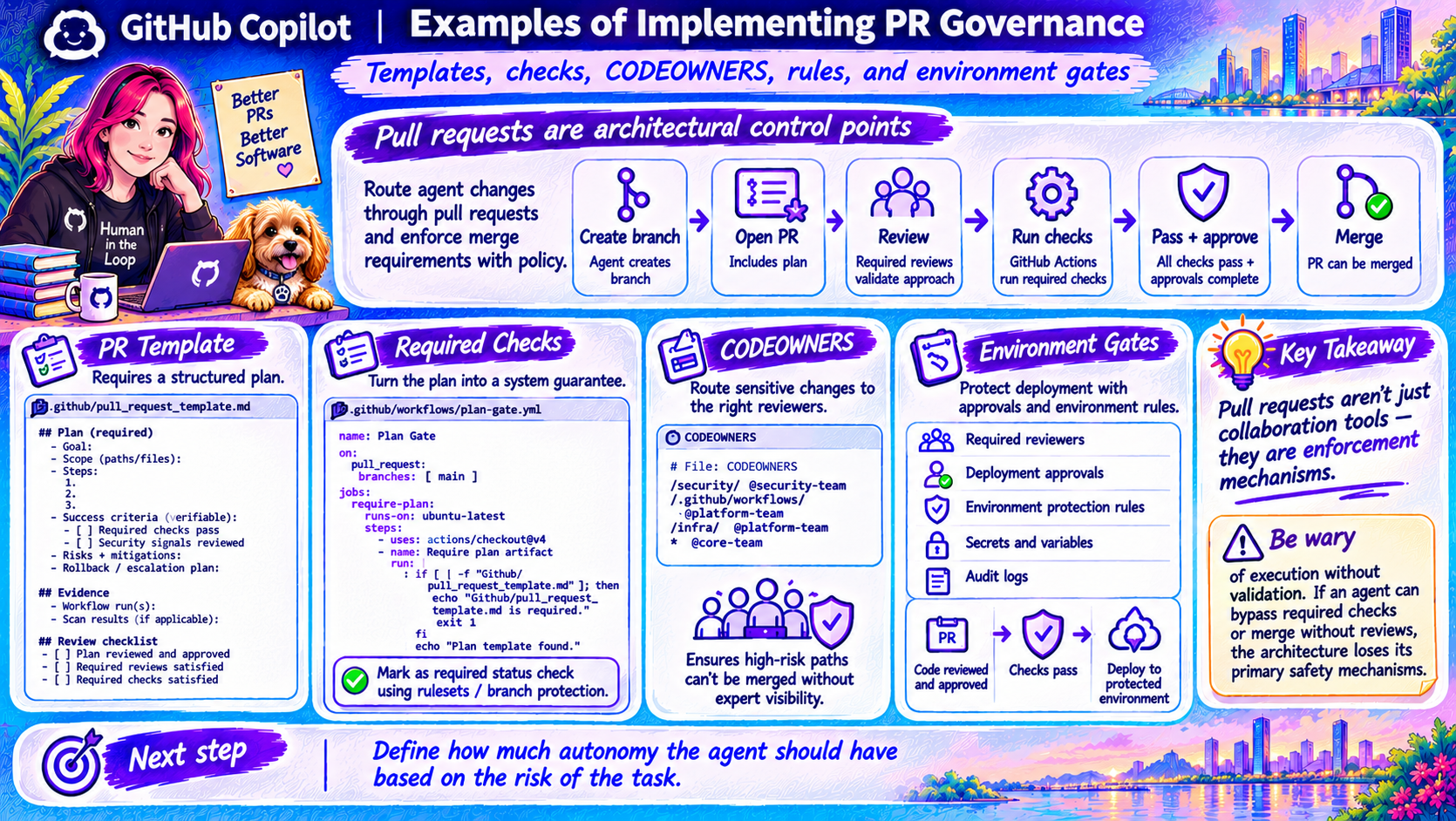
This companion infographic revisits templates, checks, ownership and environment gates, then asks how much autonomy is appropriate. The answer depends on the impact of the task, not just how quickly an agent can perform it.
Make approval meaningful
Define what reviewers approve: the proposed approach, the actual diff, the validation evidence or a deployment to a specific environment. These are distinct decisions. An approved plan does not automatically approve a later production release.
Route sensitive files to appropriate reviewers and protect changes to the enforcement mechanisms themselves. Keep approval evidence connected to the change.
Prevent bypass paths
An architecture loses its intended boundary if an agent can bypass checks, merge without the required review or alter production directly. Restrict capabilities independently from its prompt.
Start with bounded, reversible tasks. Increase autonomy only after the relevant controls and outcomes have been demonstrated, and retain an escalation path when the situation no longer fits the approved scope.
For a broader treatment of coordination, memory, evaluation and governance, see Developing in Agentic AI Systems - Part 2. The Agents and Subagents guide explains focused delegation; isolate responsibilities and do not give a delegate broader permissions than its coordinator.