Chapter 13: Where to Go From Here
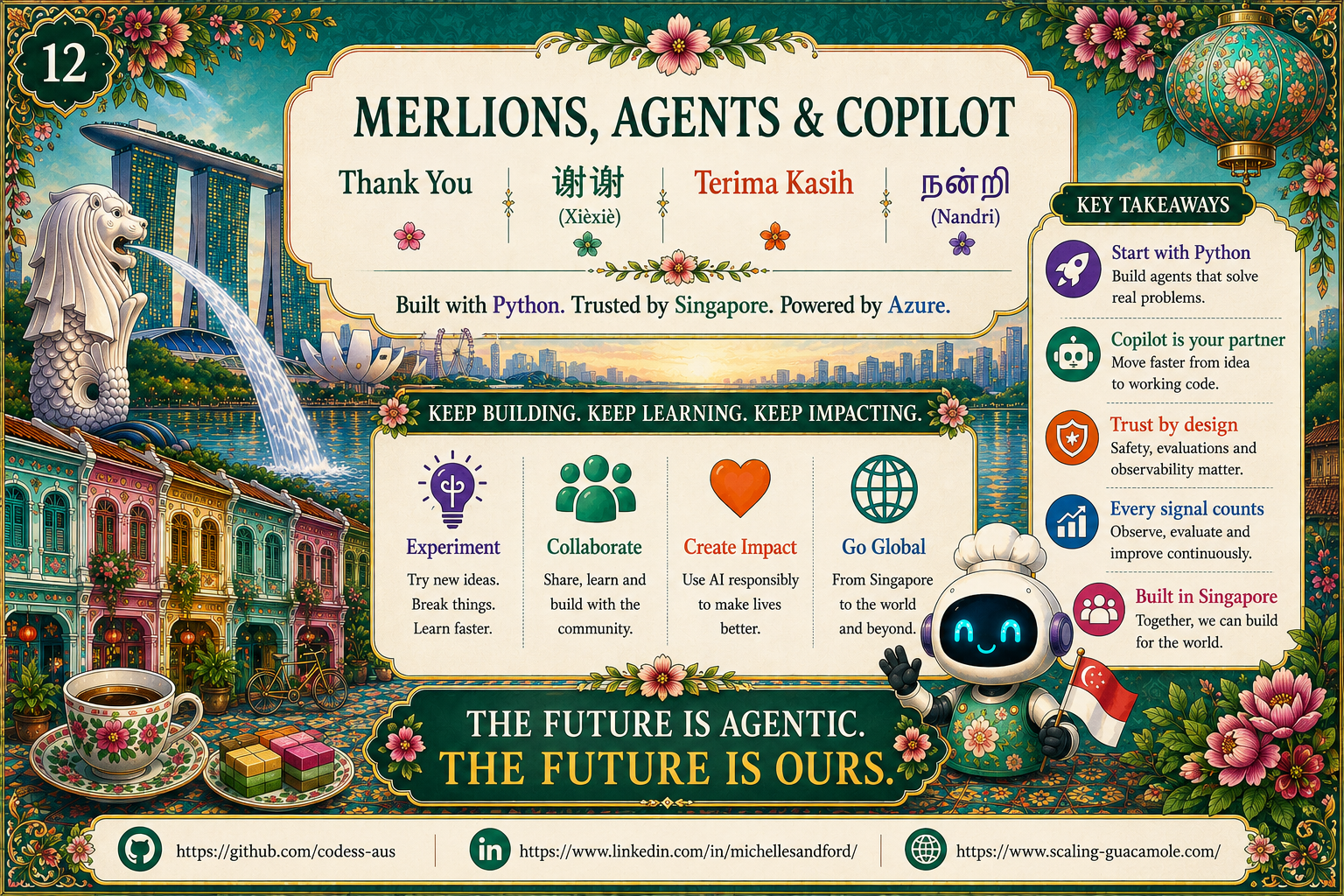
Three takeaways to carry home.
Three takeaways
- Specialise your agents. Small, focused, governed. Not one mega-agent, but several little ones that collaborate. Smaller agent, smaller blast radius.
- Build trust in, not on. Transparency, safety, reliability, observability, designed in from line one. Retrofitting trust is ten times more expensive.
- Ship to Azure with observability from day one. Container Apps, Cosmos, Key Vault, Application Insights. A boring stack with reliable outcomes.
If you are a developer
Do this in your next week. It changes how you build forever:
- Ship one tool with a typed signature and input validation.
- Add one guardrail as policy-as-configuration.
- Write one eval from a real failure.
If you are a decision maker
Go back to your team and ask three questions. If you don't get clear answers, you've found your roadmap:
- Where are our agents' guardrails?
- Where are our traces?
- Where are our evals?
The closing thought
Singapore works because everyone respects the system: the queue at the hawker stall, the rules of the MRT, the trust that lets a million strangers cooperate every day. Our agents need the same thing: personality, yes; speed, absolutely; but trust is what makes them useful at scale.
Go build agents that are friendly, fast, and trustworthy. Singapore style. Lah, let's build. 🦁
Where to go next
- The chapters: revisit Chapter 6 (Trust), Chapter 11 (Azure), and Chapter 12 (Observe) as your build checklist.
- Build 2026 sessions: search for BRK250, LTG405, and DEM303 on the Microsoft Build website.
📺 Build 2026 grounding: DEM303 (Late to agentic coding? Don't panic, build.), the encouragement to just start.