Chapter 10: Merlion Wisecracker Agent
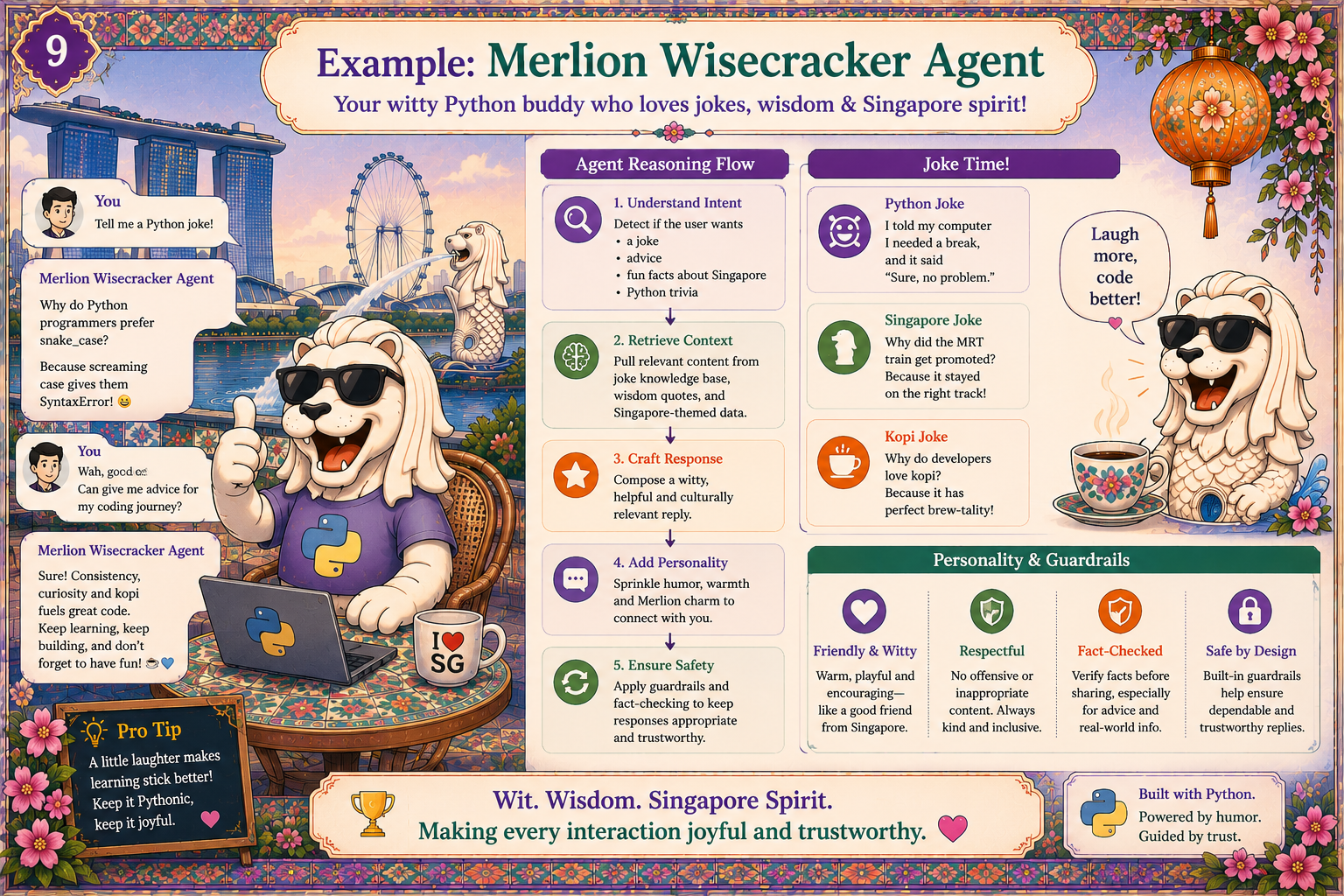
"Why do Python devs love the sea? Because they prefer high tide and high code quality." The joke is fun. The system around it is serious: personality, safe by design, grounded responses.
Personality with guardrails
The Wisecracker has the same trustworthy foundation as the other two agents, plus a personality layer on top:
- A content guardrail scans inputs and tool arguments for unsafe patterns.
- A personality prompt with explicit do's and don'ts keeps the tone in bounds.
- A refusal path for when input gets weird: humour never overrides safety.
Personality is a product feature. Trust is what lets you ship it. Without the guardrails, you would never let this agent talk to a real customer.
Walkthrough: all three agents on one composite question
Send a single question that touches all three domains:
When you run it, you'll see:
- The router classifies intent and dispatches to all three agents in parallel (see Chapter 4).
- Each agent uses only the tools on its own allowlist: the Hawker agent can't read PSI; the Haze agent can't tell jokes.
- A composed answer where every factual claim has a citation, and the pun is the only thing without one, intentionally, because humour is opinion, not fact.
- A trace tree: one parent span, three children, ~600ms end-to-end.
Why the un-cited pun is correct
Citations attach to factual claims. The joke is explicitly opinion/humour, governed by the humour policy. Separating "fact that must be grounded" from "opinion that must be safe" is a deliberate design choice, not an oversight.
Key terms
- Content guardrail: a filter that scans inputs and tool arguments for unsafe or sensitive patterns.
- Personality prompt: explicit tone instructions (do's and don'ts) layered over the safe foundation.
- Composite question: one user message that requires several agents to answer fully.