Chapter 5: GitHub Copilot to the Rescue
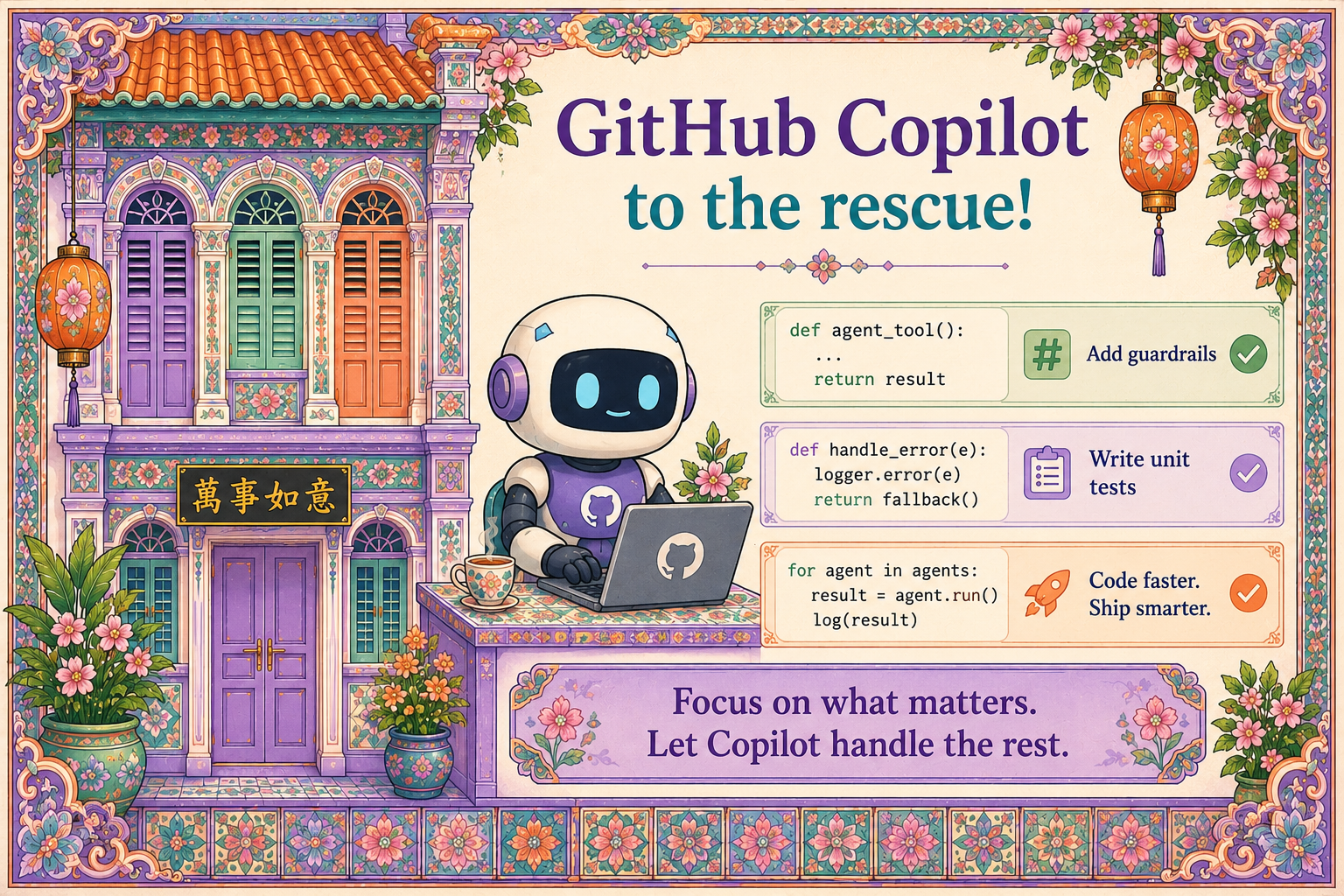
Building a multi-agent system involves a lot of plumbing: tools, schemas, guardrails, tests, traces. GitHub Copilot changes the economics. Not by writing the agent for you, but by writing the boring, safety-critical scaffolding fast and consistently.
The key idea
Copilot accelerates the safe parts, so you spend your brain on the interesting parts: agent behaviour and user experience.
Your domain expertise still matters. What Copilot removes is the repetitive cost of doing things correctly: typed signatures, input validation, policy wiring, and unhappy-path tests.
Teach Copilot your standards (do this first)
Out of the box, Copilot does not know your conventions. Fix that with repository-level instruction files:
| Mechanism | What it does | Where |
|---|---|---|
.github/copilot-instructions.md |
Repo-wide instructions every interaction follows | Repo root |
| Rules files | Topic-specific rules (security, testing, architecture) | .github/copilot/ |
| Prompt files | Reusable prompts for common workflows | .github/copilot/prompts/ |
| Custom agents & skills | Org-specific workflows Copilot can execute | Org-level |
Good instructions for trustworthy Python agents:
- "Always use type hints."
- "Validate inputs with Pydantic models."
- "Never log PII or secrets."
- "Use structured logging with correlation IDs."
- "Load policy from config, never hardcode it."
Why it matters
When the surrounding code already follows a pattern, Copilot extends that pattern, even when you do not ask. Conventions become contagious, in a good way. That is why instruction files are the highest-leverage 20 minutes you can spend before generating any code.
Key terms
- Scaffolding: the supporting structure around your real logic: types, validation, tests, telemetry.
- Custom instructions: repo/org files that teach Copilot your standards so its suggestions match your codebase.
- TDD with Copilot: write (or generate) tests first, then let Copilot implement against them.