Chapter 4: Multi-Agent Systems Working Together
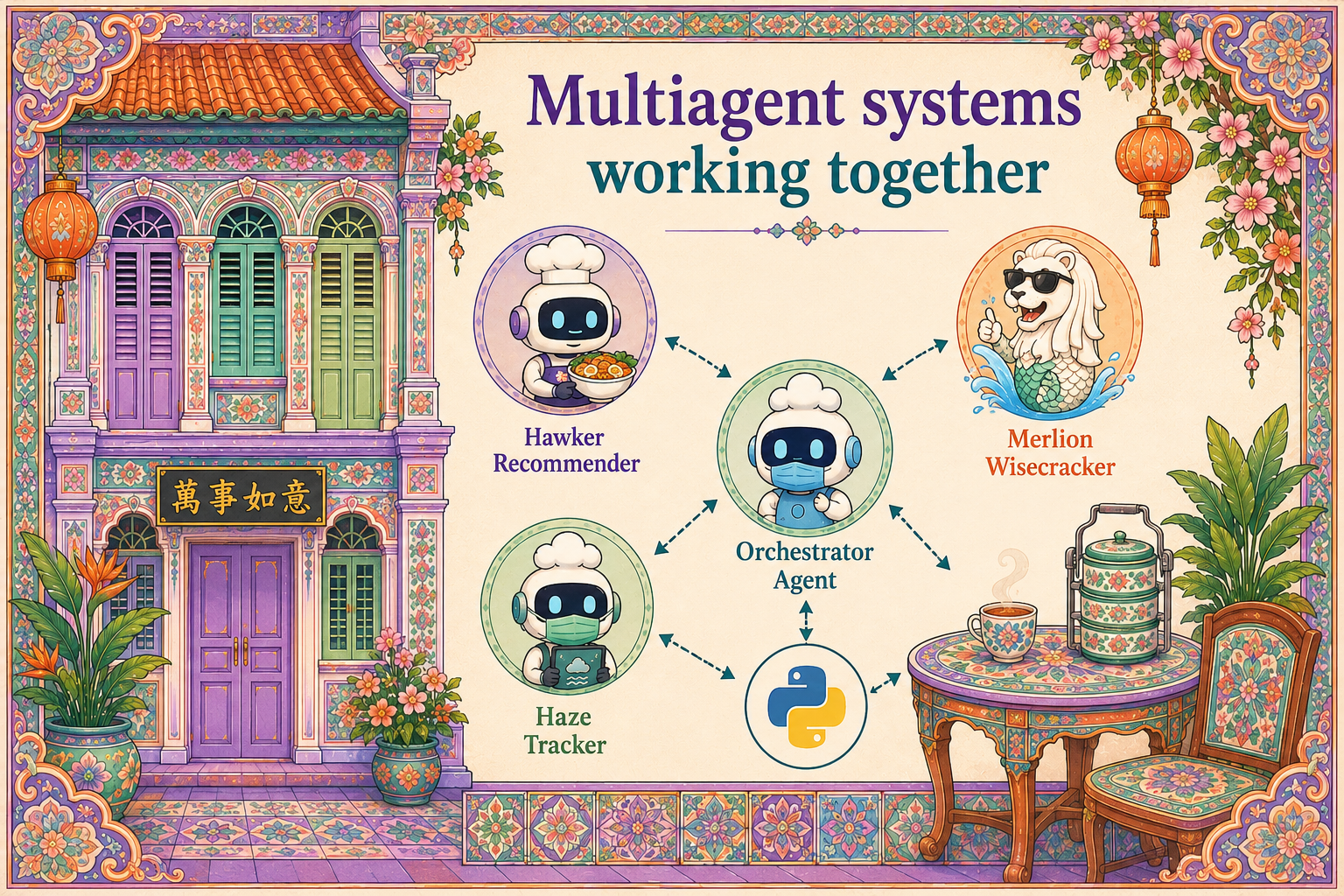
Three specialised agents are only useful if they work together. The orchestration is simple: a user asks a question, a router (also called a coordinator or supervisor) decides which agents to call, the agents do their work in parallel, and the router composes the final answer.
The kopitiam analogy: you order, the auntie at the till routes your order to the right stall: chicken rice here, laksa there, kopi over there. Each stall is an expert. Nobody tries to do everything.
How it works (for developers)
The router is just another agent whose only job is routing, and whose tools are the other agents. That keeps the system composable: you can add a fourth agent next week without rewriting the first three.
User question
      │
   ┌──┴──┐  router classifies intent
   │router│  → dispatch (parallel)
   └──┬──┘
 ┌────┼─────┐
 ▼    ▼     ▼
hawker haze wisecracker     ← each least-privilege
 │    │     │
 └────┼─────┘
      ▼
 composed, cited answer
Why it matters (for decision makers)
This is how you scale capability without scaling risk. Each agent has least-privilege tool access and its own audit trail and kill switch. You are not building one fragile super-brain; you are composing several small, governable experts.
The Python ecosystem
The pattern is framework-agnostic. PydanticAI, CrewAI, LangGraph, and AutoGen all support router/coordinator topologies. Pick the one your team likes; the pattern is what matters, not the library.
Key terms
- Router / coordinator / supervisor: the agent that classifies intent and delegates to specialist agents.
- Composable: you can add or replace one agent without touching the others.
- Fan-out / fan-in: dispatch to several agents in parallel, then merge their results into one answer.