Chapter 11: From Local to Cloud: Azure
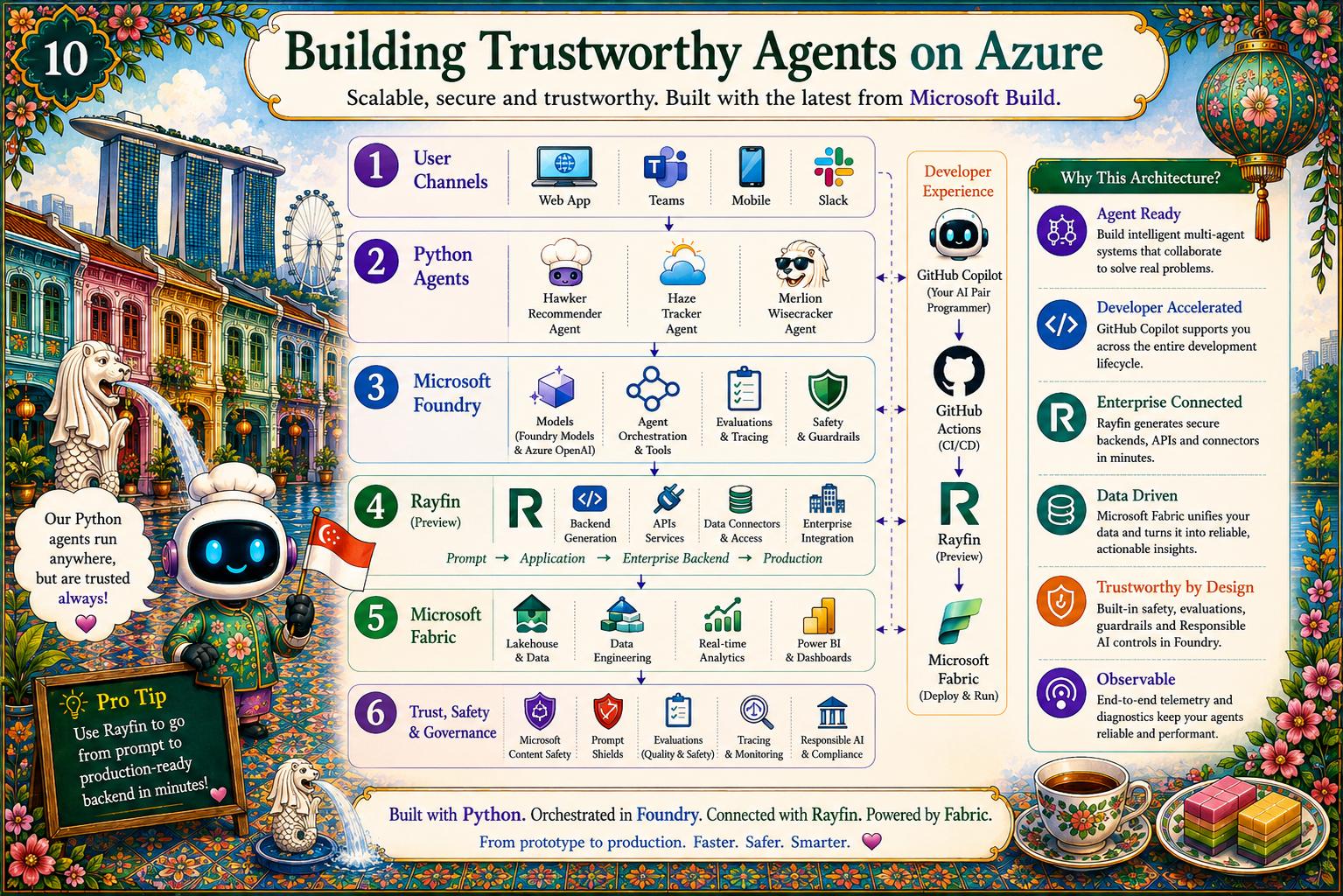
Here is a layered architecture for shipping trustworthy agents on Azure, with the reassuring news that you don't need a Kubernetes cluster or a platform team. A small set of managed services does the job.
The core four (start here)
| Service | Role | Why it fits agents |
|---|---|---|
| Azure Container Apps | Run the agents | Serverless, scale-to-zero, revisions for safe rollout + instant rollback |
| Application Insights (Azure Monitor) | Observability | Traces every tool call and guardrail decision via OpenTelemetry |
| Azure Cosmos DB | State + RAG store | Low latency, multi-region, fits the agent access pattern |
| Azure Key Vault | Secrets | API keys and endpoints out of code, forever; managed identity does the rest |
A Python agent can be in production the same afternoon: az containerapp up
once the basics are set.
The trust layer (this is where Build 2026 lands)
On top of the runtime, wire in the platform safety services:
- Content Safety / Prompt Shields: block jailbreaks and prompt injection at the boundary.
- Evaluations: continuous, sampled quality + safety scoring on real traffic.
- Tracing: OpenTelemetry GenAI spans flowing into Application Insights.
- Responsible AI: policies, red-teaming, and human-in-the-loop for high-impact actions.
On Microsoft Foundry, much of this is built in: agent hosting, the Observability dashboard, and continuous evaluation in one place.
The data layer: Microsoft Fabric + Rayfin
Grounded agents are only as good as the data behind them, so the architecture includes a data layer:
- Microsoft Fabric: the unified analytics platform where your RAG sources, eval datasets, and telemetry can live and be governed together.
- Rayfin (Preview, announced at Build 2026): Microsoft Fabric's way to build enterprise apps faster on top of your Fabric data. For an agent, it shortens the path from "data in Fabric" to "an app/endpoint your agent can call," so the grounded store stays close to the analytics it came from. See Build enterprise apps faster with Rayfin.
The point for builders: keep your grounding data, evals, and observability on one governed platform so the feedback loop in Chapter 12 has clean, trustworthy inputs.
Patterns worth naming
- Separate the agent runtime from the data plane. Container Apps for the agent, Cosmos for state, Key Vault for secrets, App Insights for telemetry. Upgrade any one piece without breaking the others. That is how you survive 18 months of model and framework churn.
- Use managed identity between Container Apps, Cosmos, and Key Vault. No secrets to rotate.
- Put prompts and policies in config, not code, so you can change a guardrail without redeploying.
- Turn on Application Insights on day one, not day ninety. Retrofitting traces is painful.
Why it matters (for decision makers)
Every service here is managed: Microsoft handles patching, scaling, and redundancy. Your team spends its time on agent behaviour and user experience, which is the only place your competitive advantage lives. And each service has a Southeast Asia regional presence, so data stays close and compliance teams stay happy.
Key terms
- Scale-to-zero: pay nothing when idle; scale up on demand. Ideal for spiky agent traffic.
- Managed identity: service-to-service auth with no stored secrets
(
DefaultAzureCredentialin Python). - Data plane vs. runtime: keep where the agent runs separate from where data lives.
- Microsoft Foundry: Microsoft's agent platform (agents, evaluation, observability); the current name evolved from Azure AI Foundry.
- Microsoft Fabric: the unified, governed data + analytics platform that can hold your RAG sources, eval datasets, and telemetry.
- Rayfin (Preview): a Microsoft Fabric capability for building enterprise apps faster directly on Fabric data.