Chapter 6: Trust Is Our Architectural Style
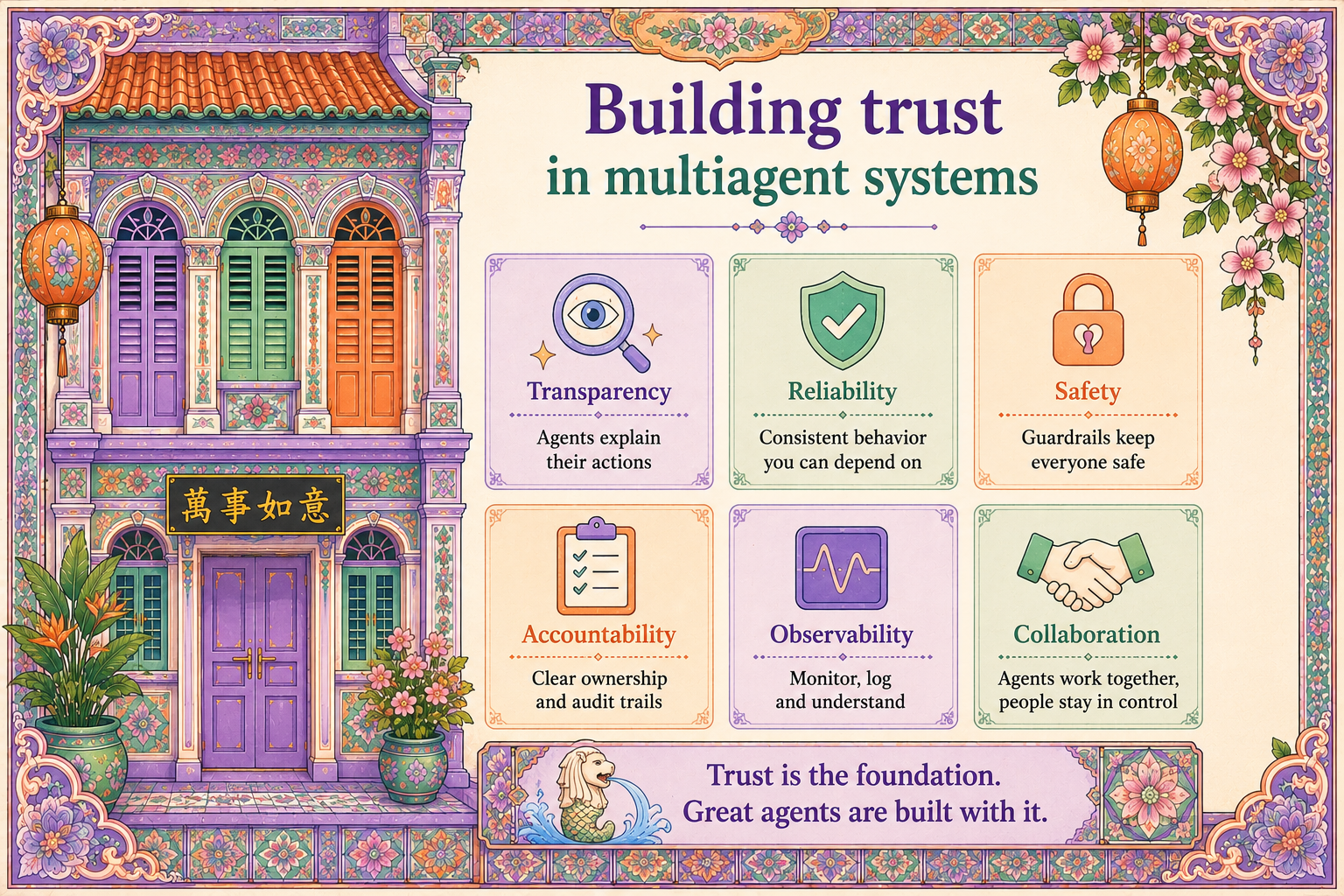
Think of trust as four pillars. Like the load-bearing walls of a Peranakan shophouse, they are not decoration added at the end. Trust is the style that runs through every wall.
| Pillar | What it means | In this repo |
|---|---|---|
| Transparency | The agent explains its decisions and cites sources | require_citation in policy config |
| Safety | Guardrails, validation, allowlists, content checks (fail closed) | Governance decorator on every tool |
| Reliability | Retries, fallbacks, idempotency | Haze fallback chain, dedupe keys |
| Observability | Logs, metrics, traces for every decision | OpenTelemetry spans on every call |
Each pillar, concretely
- Transparency: "Why this hawker stall? Because of these reviews, this distance, this menu match." Never "because the model said so."
- Safety: input validation, output filtering, tool allowlists, content checks. Fail closed: if a check errors or is ambiguous, deny the action.
- Reliability: if the maps API is down, fall back to cached data and say so. If the user asks twice, do not double-book. Boring. Critical.
- Observability: every tool call, every guardrail decision, every refusal. If you can't see it, you can't trust it.
This is now an industry standard
The four pillars line up with the Build 2026 throughline:
- Trace with OpenTelemetry's GenAI semantic conventions.
- Enforce with the new Agent Control Specification, a universal runtime standard that turns agent safety from best-effort into deterministic control (tool allowlists, content filters, rate limits, human-in-the-loop).
- Improve with continuous evaluation on every agent action.
Why it matters (for decision makers)
These four words are also how you have a sensible conversation with security and compliance. Instead of "it's AI, it's magic," you can say: "here's the allowlist, here are the traces, here's the eval suite."
If a vendor pitches you an agent and can't show you all four pillars, walk away. If you are a developer, design them in from line one. Retrofitting trust is ten times more expensive.
Key terms
- Fail closed: when uncertain, deny. The safe default.
- Policy as configuration: guardrails live in YAML, not hardcoded, so they can change without a redeploy.
- Audit trail: a durable, queryable record of what the agent decided and why.