Chapter 9: Haze Tracker Agent
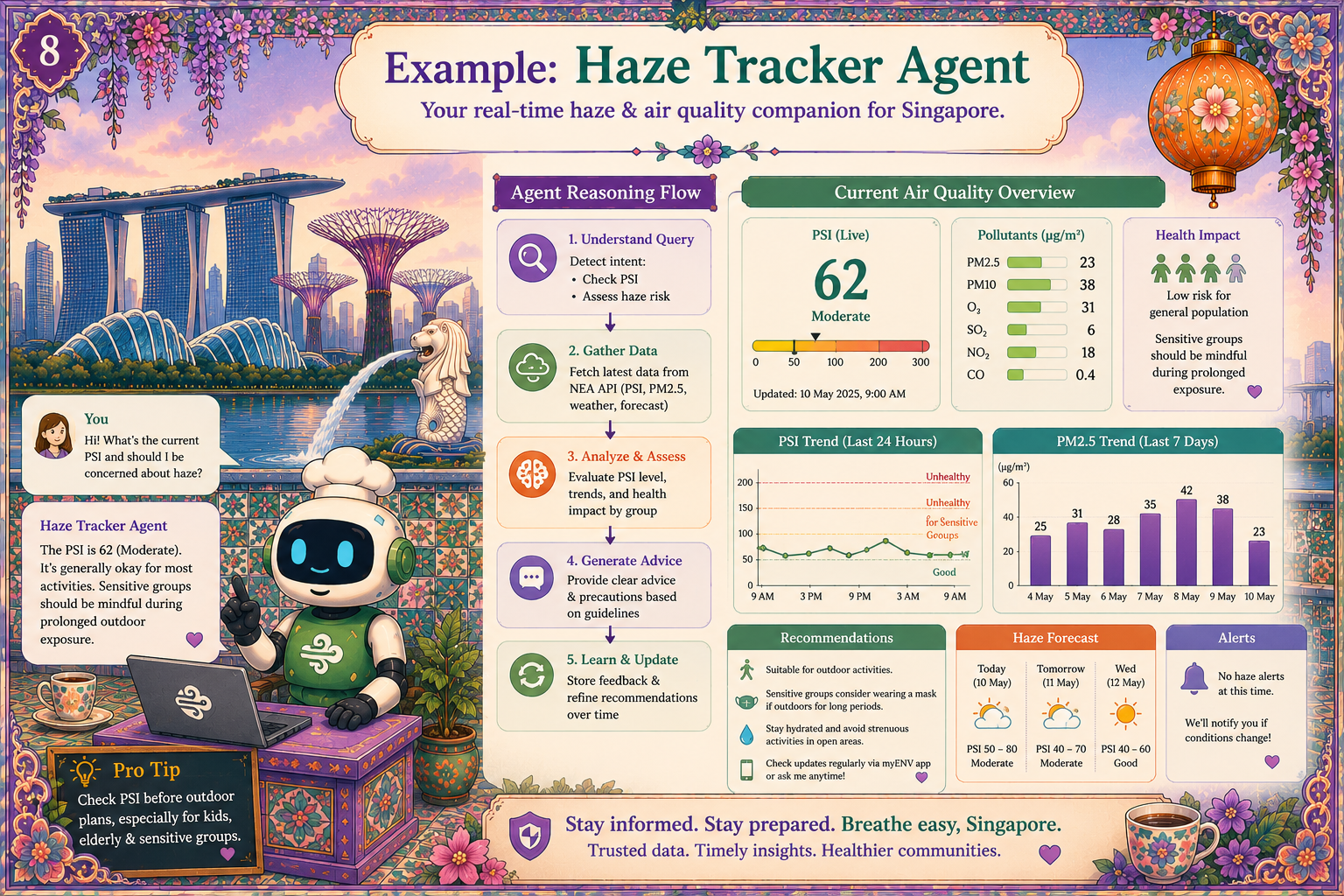
Consider a typical response: "PSI eighty-two, moderate. Take care, drink water, stay indoors." Anyone who has lived through a Singapore haze season knows this is not a toy. People use this to decide whether to send kids to school or run outside. The cost of a wrong answer is real.
The pattern: ingest → forecast → alert
1. Ingest. The agent pulls from NEA's public PSI feed. Tool use, allowlisted, read-only.
2. Forecast. A small forecasting step projects the next few hours and attaches a confidence score. Low confidence? The agent says so. It does not fake certainty.
3. Alert (idempotent). If the PSI crosses into "unhealthy" at 7am, you get one alert. Not five. Not one per refresh. The agent remembers what it told you and does not spam you at 3am unless something truly changed.
Two reliability properties to steal
Idempotency
The most under-rated property in agent design.
It is the difference between a useful assistant and a creepy stalker. Implement a dedupe key on every external side-effect so repeating the same action is a no-op.
Fallback chain
The Haze agent degrades gracefully:
- NEA live feed
- Cached data
- A clear "data unavailable, please check nea.gov.sg" message
It never invents a PSI number. Failing visibly beats failing silently, every time.
The bigger point
The Hawker and Haze agents are the same trust pattern applied to different domains: same vocabulary (ingest, ground, validate, trace), same observability, same kill switch. You are not buying three bespoke products; you are buying one pattern, applied three times.
Key terms
- Idempotent: doing the same operation twice has the same effect as doing it once. Essential for alerts and any write/side-effect.
- Dedupe key: a stable identifier for an action so duplicates are suppressed.
- Confidence score: an honest numeric signal of how sure the forecast is; surfaced to the user instead of hidden.
- Graceful degradation: a defined fallback chain so the system stays useful when a dependency fails.