Chapter 8: Hawker Recommender Agent
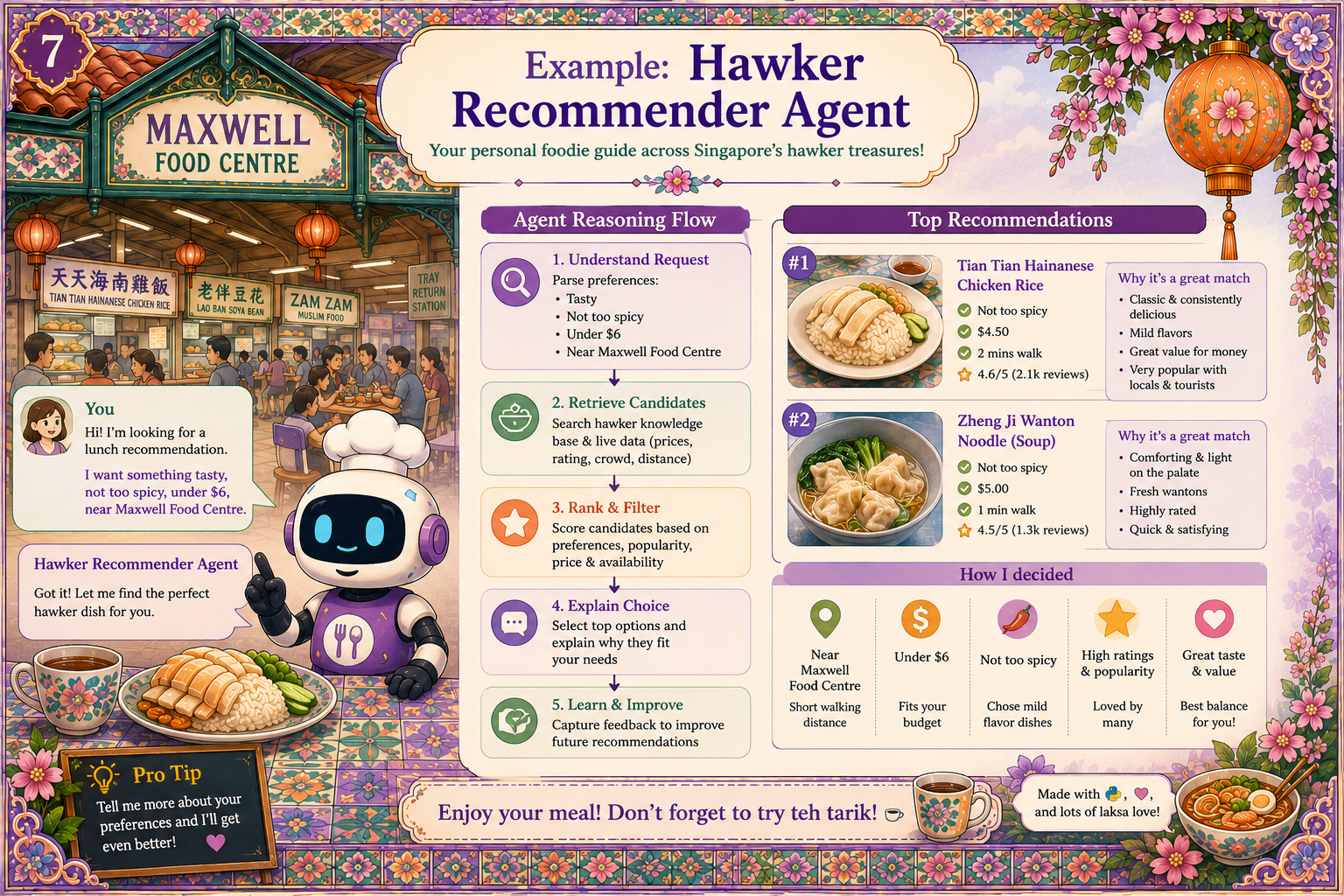
Picture a simple exchange. User: "Recommend dinner near me." Agent: "Hainanese chicken rice at Maxwell today." It looks simple, but underneath, three things happen.
The pattern: tool → retrieve → ground → cite
1. Tool use. The agent called a maps tool to find nearby hawker centres. The tool is on an allowlist: it can read locations. It cannot write, pay, or book. Least privilege.
2. RAG (retrieval-augmented generation). The agent retrieves from a verified menu dataset rather than guessing what a stall serves, then phrases it nicely. Grounded.
3. Trust. Every claim is validated against the retrieved source, and every
answer cites which stall, which review, which date. If the agent can't find a
citation, it says "I'm not sure; here's what I do know." Honest about
uncertainty. The hawker policy sets require_citation: true.
Why "grounded" actually matters
Grounded means the output is traceable to a source you control.
So when a user complains about a bad recommendation, you can debug it: fix the data, add a test, ship. It is an engineering problem, not a mystery.
And note what we did not do: we did not fine-tune a model on hawker data. Tool use plus retrieval gets ~90% of the value at ~10% of the cost. Keep that in your back pocket the next time someone pitches an expensive fine-tune.
Refusal is a feature
If the user shares no location and no preference, the Hawker agent refuses and asks for one. It does not pick a random stall. A refusal beats a hallucination every time.
Key terms
- RAG: retrieve relevant facts from a trusted store, then let the model phrase them. Reduces hallucination dramatically.
- Citation: a pointer to the exact source backing each claim
(e.g.
menu_index/satay-bay/2026-06-13). - Least-privilege tool: read-only where possible; no side effects unless explicitly required and approved.