Chapter 12: Observe. Evaluate. Improve.
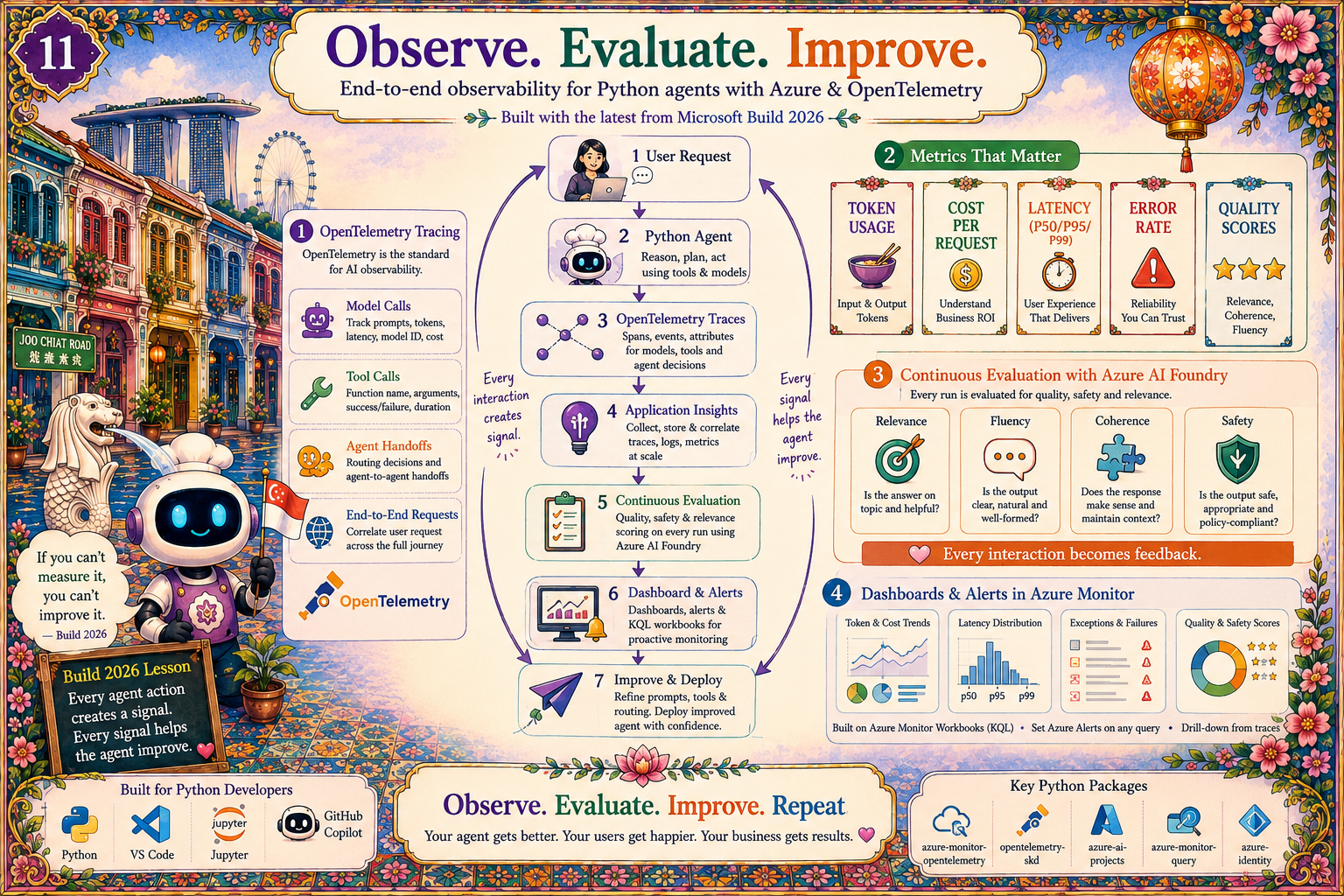
Trustworthy agents run on a continuous feedback loop: Collect → Understand → Improve. Picture it as a circle, where every agent action becomes a signal that feeds the next improvement.
The loop
Collect: logs, metrics, traces. Every tool call, every guardrail decision, every refusal, every latency. Default on. Emitted as OpenTelemetry spans.
Understand: dashboards and alerts. What's slow? What's failing? Which guardrails are firing, too much or not enough?
Improve: feedback loops and evals. Take real traces, turn them into eval cases, run them every CI build. The agent gets measurably better, week over week.
A worked example
Here is what the loop looks like in action:
- A real tool-call trace in Application Insights, ~380ms end-to-end, with
custom dimensions:
agent_id,policyversion,decision=allow,tools_used. - A guardrail rejection logged with the matched rule and redacted evidence, not the user's raw prompt. Log decisions, not content.
- The eval loop closing: a real rejection becomes the next eval case and catches a latency regression overnight.
Continuous evaluation (the Build 2026 push)
Beyond your own eval cases, Microsoft Foundry offers continuous evaluation: built-in evaluators scoring a sampled slice of real traffic:
- Quality: Relevance, Groundedness, Coherence, Fluency.
- Safety / risk: jailbreak detection, protected-material and code- vulnerability checks, hate/violence/self-harm/sexual content.
- AI Red Teaming Agent: automatically probes for jailbreaks, prompt injection, and data exfiltration.
The mantra: Observe. Evaluate. Improve. Roll out safely. Repeat.
Privacy by design
Log the decision and the rule, never the raw prompt.
This keeps your audit trail useful and your privacy review happy. Evidence is the redacted pattern match, plus a redacted user ID: enough to debug, not enough to leak.
Key terms
- OpenTelemetry (OTel): the open standard for traces/metrics/logs; the GenAI semantic conventions add model/tool/agent spans.
- Continuous evaluation: automated quality + safety scoring on sampled production traffic.
- Eval case: a recorded input + expected behaviour that runs in CI to catch regressions.
- Trace span: one timed unit of work (a tool call, an LLM call) within a larger request tree.