Chapter 13: Measurement Challenges
Overview
Unfortunately, evaluating generative AI systems can be a real challenge.
In traditional ML, data scientists are typically chasing one metric: accuracy. And you can calculate accuracy by dividing the number of correct predictions by the total number of predictions.
For generative AI, we may also be interested in accuracy—which we can evaluate if we have ground truth.
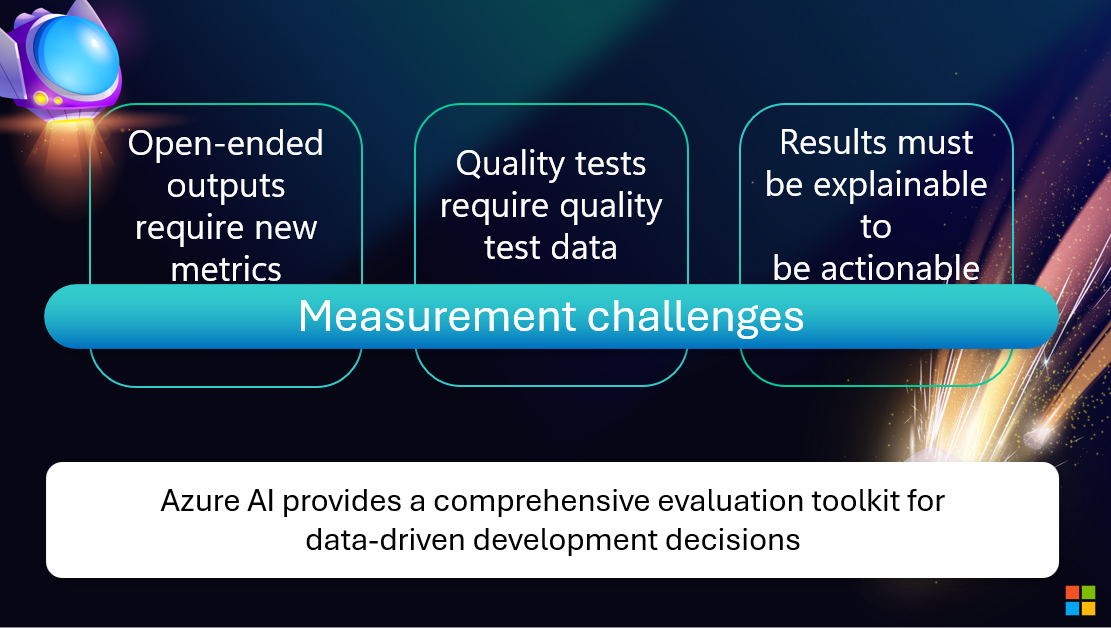
But we may also be interested in very different metrics, for more open-ended outputs. For example, we may want to assess whether our model or application outputs are fair, grounded in our source data, or grammatically correct. That's a little more complex than accuracy.
We also need good test data. You might already have good test data, like typical questions from your customers and your model's response to those questions, from your customer service team or another business unit—but you might not have high quality test data for edge cases, like prompts with the latest jailbreaking techniques.
Key Measurement Challenges
Generative AI evaluation requires new approaches beyond traditional ML metrics:
- Open-ended Outputs: No single "correct" answer to compare against
- Multi-dimensional Quality: Need to assess groundedness, relevance, coherence, fluency simultaneously
- Edge Case Coverage: Difficult to generate comprehensive adversarial test data
- Human Judgment at Scale: Manual evaluation doesn't scale to production volumes
- Evolving Threats: New jailbreak techniques emerge constantly
Azure AI Foundry's Approach
Azure addresses these challenges with hybrid evaluation approaches:
- AI-Assisted Metrics: Use GPT-4 as a judge for nuanced quality assessment
- Synthetic Data Generation: Create edge case test data programmatically
- Continuous Evaluation: Monitor production traffic for regression
- Red Team Integration: Automated adversarial testing with PyRIT
Measurement challenges are real, but Azure AI Foundry provides production-tested solutions. The key is combining multiple evaluation approaches to build comprehensive quality assurance.
Resources and Further Reading
Another challenge is explainability. To make data-driven development decisions and really debug our system, we need to be able to understand why our model or application scored our model outputs a certain way.
At Microsoft, we needed to figure all of this out so we could systematically evaluate our own copilots before deploying to production.
Now, Azure AI provides a robust toolkit for evaluating generative AI in a repeatable, transparent way.
Resources and Further Reading
Online Resources
Next Steps
Continue your learning journey:
Questions or feedback? Join the discussion on our GitHub repository or connect with the community.