Chapter 6: Ethical and Policy Alignment
Overview
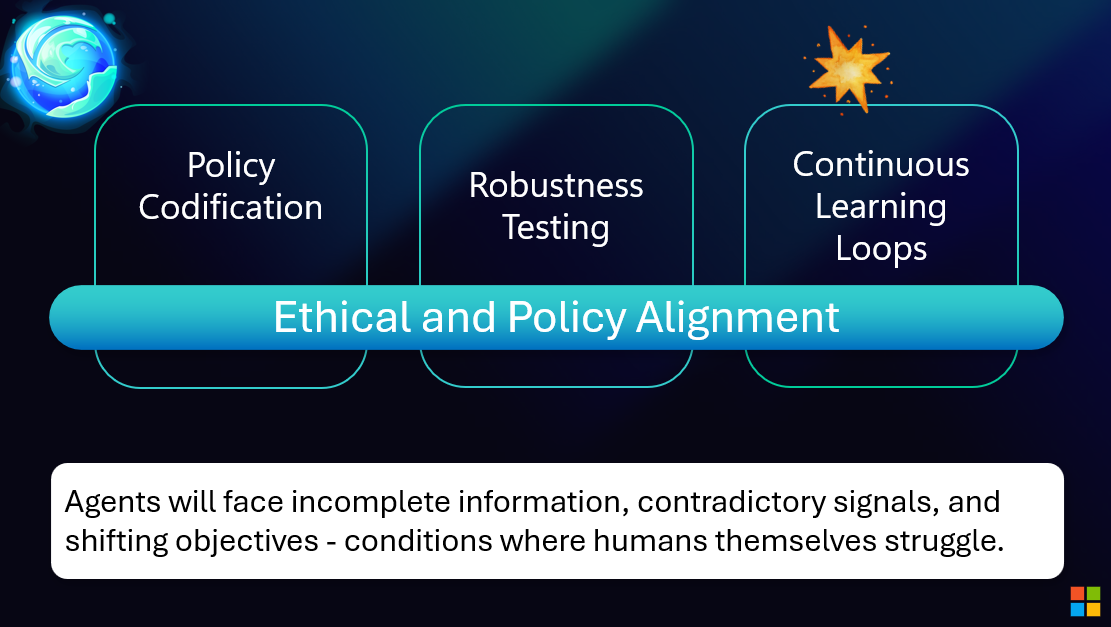
Agents will face incomplete information, contradictory signals, and shifting objectives - conditions where humans themselves struggle.
Design Tactics for Ethical Alignment
Failover Strategies: For critical processes, agents should be able to gracefully degrade or escalate to human-in-the-loop, rather than making brittle or catastrophic decisions.
Robustness Testing: Simulate edge cases, adversarial scenarios, and "unknown unknowns." Agents should be tested with the same rigor as disaster recovery drills.
Continuous Learning Loops: Integrate real-world feedback as a core design principle. Agents must be able to learn from past errors and user corrections, not just retrain on static data.
Operationalizing Ethics with Azure AI Foundry
Ethical AI requires both principles and practical enforcement mechanisms:
- Policy as Code: Define ethical constraints in system prompts and Azure Policy
- Human Oversight Integration: Configure approval workflows for high-stakes decisions
- Feedback Loops: Use Azure AI Foundry evaluations to measure alignment with values
- Graceful Degradation: Implement fallback behaviors when confidence thresholds aren't met
GitHub Copilot and Azure AI Foundry work together to embed ethical guardrails directly into your development workflow—from code suggestions that follow best practices to deployment gates that enforce policy compliance.
Resources and Further Reading
Online Resources
Next Steps
Continue your learning journey:
Questions or feedback? Join the discussion on our GitHub repository or connect with the community.