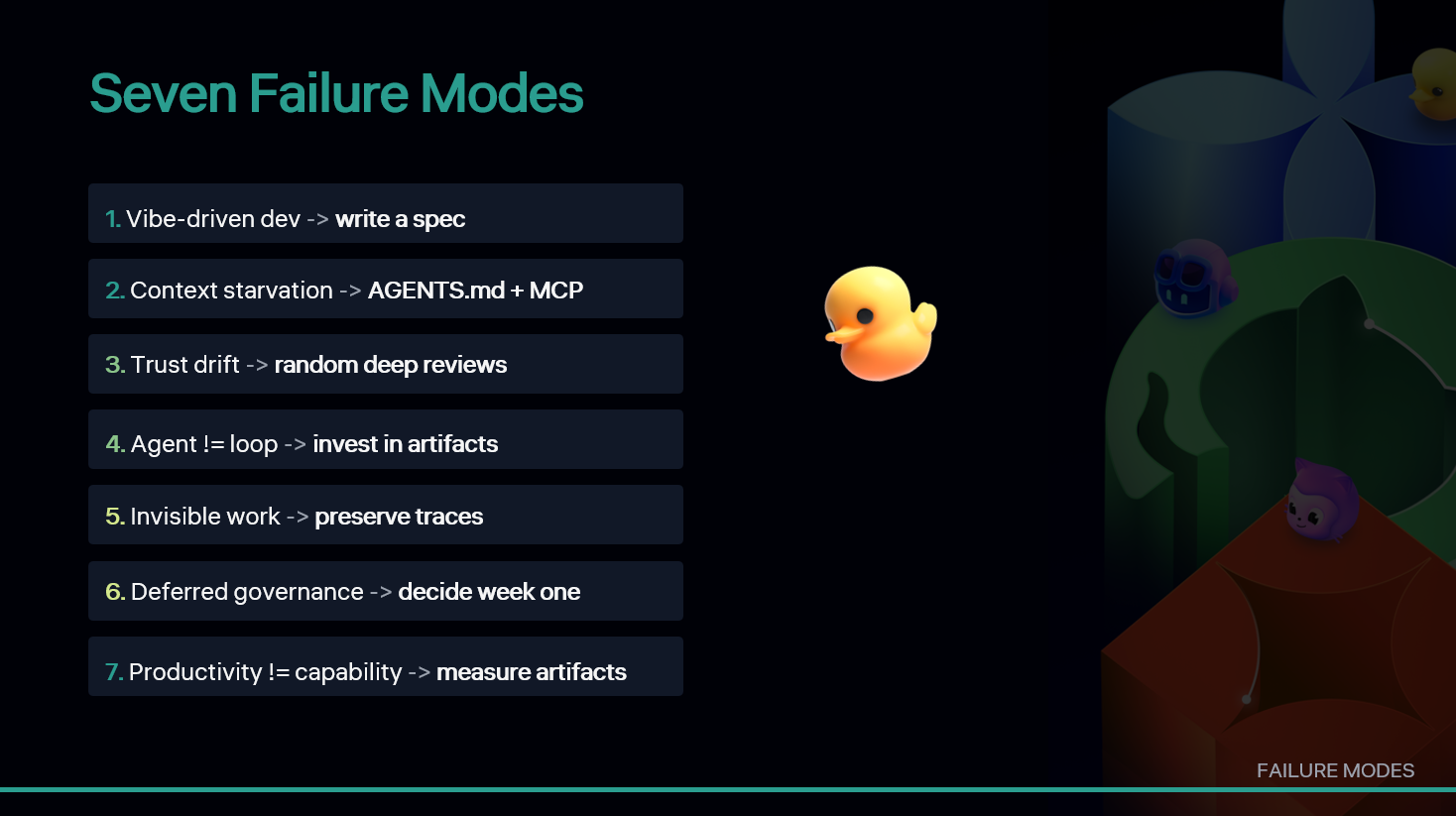
Seven Failure Modes
Recognizing common failure patterns early and turning them into concrete safeguards.
Why this chapter matters
Failure modes are useful because they convert vague anxiety into concrete preparation. Teams that can name likely failures early can design countermeasures before the cost curve steepens.
Key points for your team
Seven common failure modes in early AI-native adoption:
- Spec vacuum: implementation begins before intent is stable.
- Context drift: agents work from stale or partial constraints.
- Automation theater: impressive demos without production-grade controls.
- Policy lag: permissions and controls trail usage patterns.
- Reliability blind spots: insufficient traces and weak evidence chains.
- Accountability ambiguity: unclear human ownership at release time.
- Scale-before-discipline: autonomy increases faster than operating maturity.
These modes appear across industries because they are workflow and governance problems, not vendor-specific tool problems.
What to review with your team
Run a failure mode workshop and score each mode by:
- Likelihood in the next 90 days.
- Potential impact on customers or operations.
- Current mitigation strength.
Then assign one owner and one near-term mitigation per high-scoring mode.
The exercise is intentionally lightweight. The point is to move from awareness to ownership.
Put this into practice
Pick your top two failure modes and define measurable safeguards with dates, owners, and verification checks.