New Operating Model: Humans + Agents
How teams can increase ambition and leverage by redesigning roles around intent and accountability.
Why this chapter matters
The operating model question is often framed as substitution: what tasks can AI replace? That framing is too narrow and usually leads to short-term optimization.
The better question is leverage: how do humans and agents combine to increase responsible ambition?
Key points for your team
In strong AI-native teams:
- Humans own intent, constraints, trade-offs, and final accountability.
- Agents handle bounded execution and synthesis work.
- Review focuses on correctness of outcome, not just plausibility of code.
This creates role evolution, not role collapse. Engineers become stronger at problem framing, system judgment, and risk evaluation.
Organizations that reward only raw implementation throughput will underutilize both humans and agents.
What to review with your team
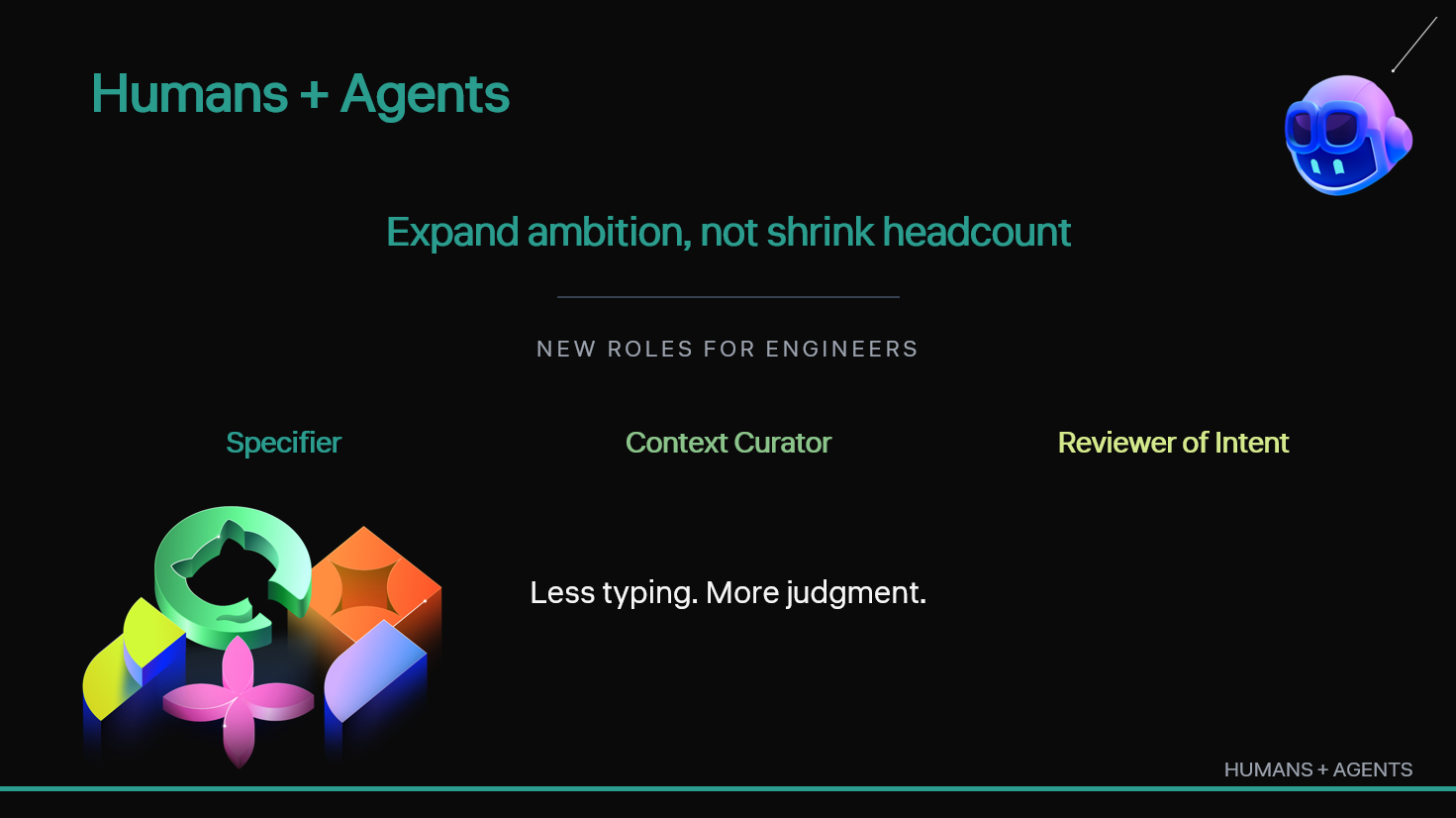
Define explicit responsibilities for three emerging capabilities:
- Specifier: translates business intent into testable delivery contracts.
- Context curator: packages constraints and relevant system knowledge.
- Outcome reviewer: validates integrated behavior and risk boundaries.
These capabilities can exist within current roles, but they must be visible, taught, and measured.
The result is a healthier system: less manual toil, more strategic engineering, and better alignment with business outcomes.
Put this into practice
Update your engineering competency framework to include intent quality, context quality, and review quality as first-class expectations.