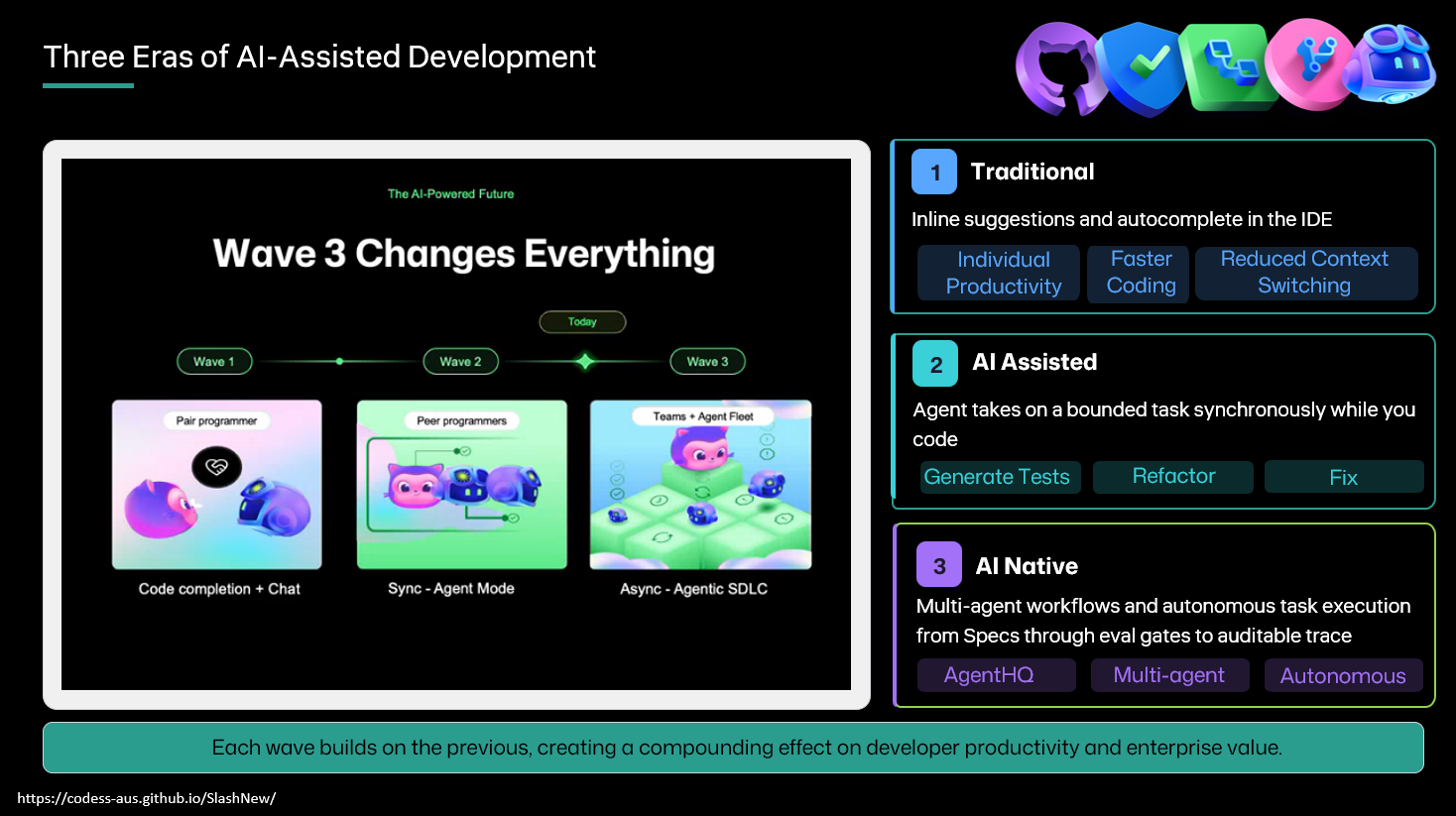
Three Eras, Side by Side
A practical model for understanding where your team is today and what AI-native progress really means.
Why this chapter matters
Most teams are not purely traditional or purely AI-native. They are hybrid. Without a shared model, discussions about maturity become vague and political.
This chapter gives you a practical map so engineering leaders can compare current behavior against desired behavior with less ambiguity.
Key points for your team
Use the three eras as a diagnostic lens:
- Traditional: humans execute every stage directly; automation is deterministic.
- AI-assisted: humans remain primary executors; AI accelerates local tasks.
- AI-native: humans define intent and constraints; agents participate across stages with traceability.
The critical distinction is not tool usage. It is whether your loop and governance assume meaningful machine participation.
This prevents two common mistakes:
- Over-claiming maturity because developers use AI tools heavily.
- Under-investing in platform and governance because teams confuse speed with system redesign.
What to review with your team
Run a workshop and score one active product team across each stage of delivery:
- Who creates and approves intent?
- How is context prepared and validated?
- What is the role of AI in implementation?
- What evidence is required for release?
You will likely find different eras coexisting within one team. That is expected. The value is visibility.
Use this visibility to define a realistic 90-day move from current state to next state.
Put this into practice
Pick one workflow, place it in the maturity model, and declare one structural change needed to progress one level. Do not choose a tooling change first; choose a loop change first.