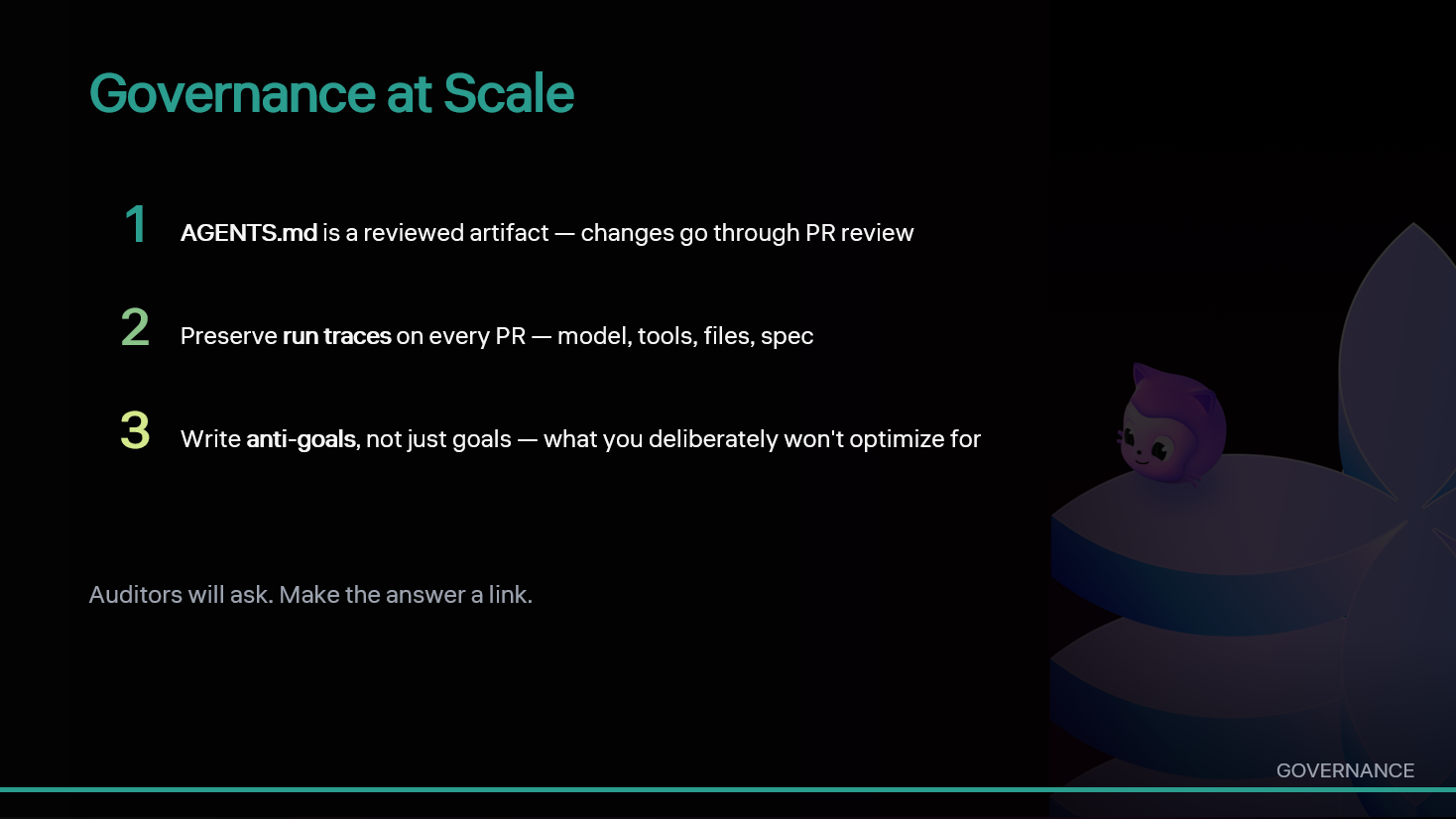
Governance at Scale
Designing governance early so speed and accountability can scale together.
Why this chapter matters
Governance is often deferred because it is seen as a drag on delivery speed. In practice, delayed governance creates larger slowdowns through rework, incident response, and cross-team mistrust.
Early governance is cheaper, clearer, and more compatible with velocity.
Key points for your team
Effective governance in AI-native delivery is artifact-centered:
- Policies are encoded in tools and workflows.
- Evidence is captured continuously, not assembled post hoc.
- Exceptions are explicit, time-bounded, and reviewable.
The goal is not to block change. The goal is to make responsible change repeatable.
This requires shared ownership between engineering, platform, security, and legal. Governance succeeds when these groups align on the same minimal artifact set.
What to review with your team
Review governance readiness in three categories:
- Evidence: what artifacts are mandatory per change?
- Accountability: who signs off by risk tier?
- Exceptions: how are deviations documented and closed?
Also define anti-goals. They prevent accidental drift by making unacceptable outcomes explicit.
Governance maturity is a competitive advantage because it allows faster scaling without trust debt.
Put this into practice
Publish a governance v1 playbook with required artifacts, risk tiers, approval paths, and exception handling, then iterate quarterly.