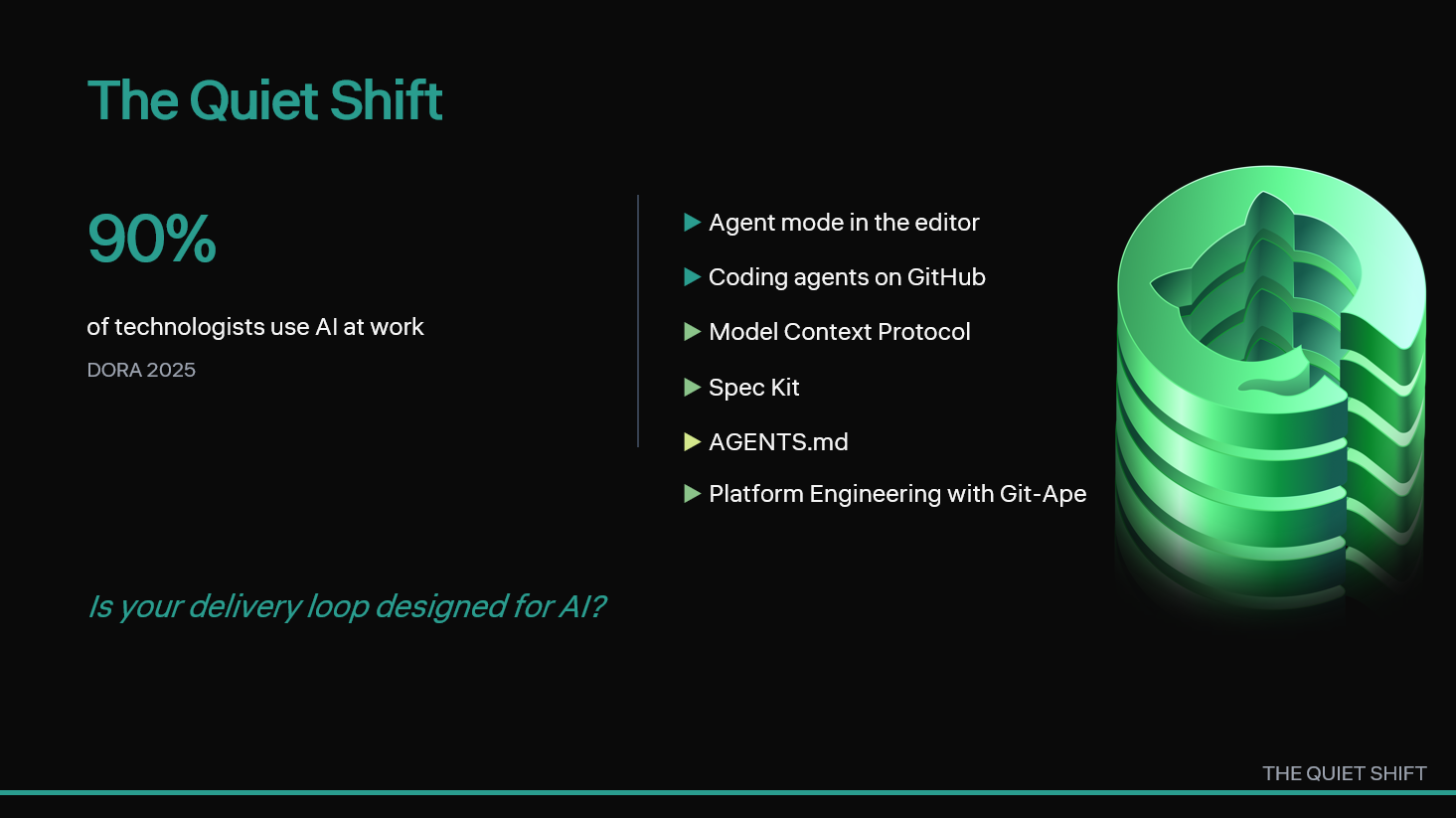
The Quiet Shift
What has already changed in software delivery, and why intentional operating models now matter.
Why this chapter matters
The shift to AI-native development did not begin with one launch event. It happened gradually: first suggestions, then chat assistants, then agents that can plan and execute meaningful code changes.
Many organizations are already in this shift operationally, but not yet organizationally. Engineers changed behavior first. Policy, controls, and role definitions are still catching up.
Key points for your team
Treat AI usage as normal delivery work, not an exceptional side activity. That means:
- It belongs in standard engineering workflows.
- It should produce reviewable artifacts.
- It must inherit the same reliability and security expectations as human-authored work.
Ignoring this reality creates shadow workflows. Teams continue using AI, but evidence and accountability drift outside your normal systems.
The opportunity is to make the invisible visible: where AI contributes, where humans decide, and where controls apply.
What to review with your team
Use this chapter as a discovery exercise:
- Map where AI already appears in daily work: ideation, coding, tests, docs, operations.
- Identify where those actions are not captured in durable artifacts.
- Define ownership boundaries for AI-assisted and agent-led tasks.
- Prioritize one workflow to formalize in the next sprint.
A team that can see this shift clearly can redesign intentionally. A team that cannot will experience it as unplanned drift.
Put this into practice
Create a one-page inventory of current AI touchpoints and classify each one as:
- Allowed and governed.
- Allowed with missing controls.
- Not allowed in its current form.
That single inventory often unlocks months of clearer decision-making.