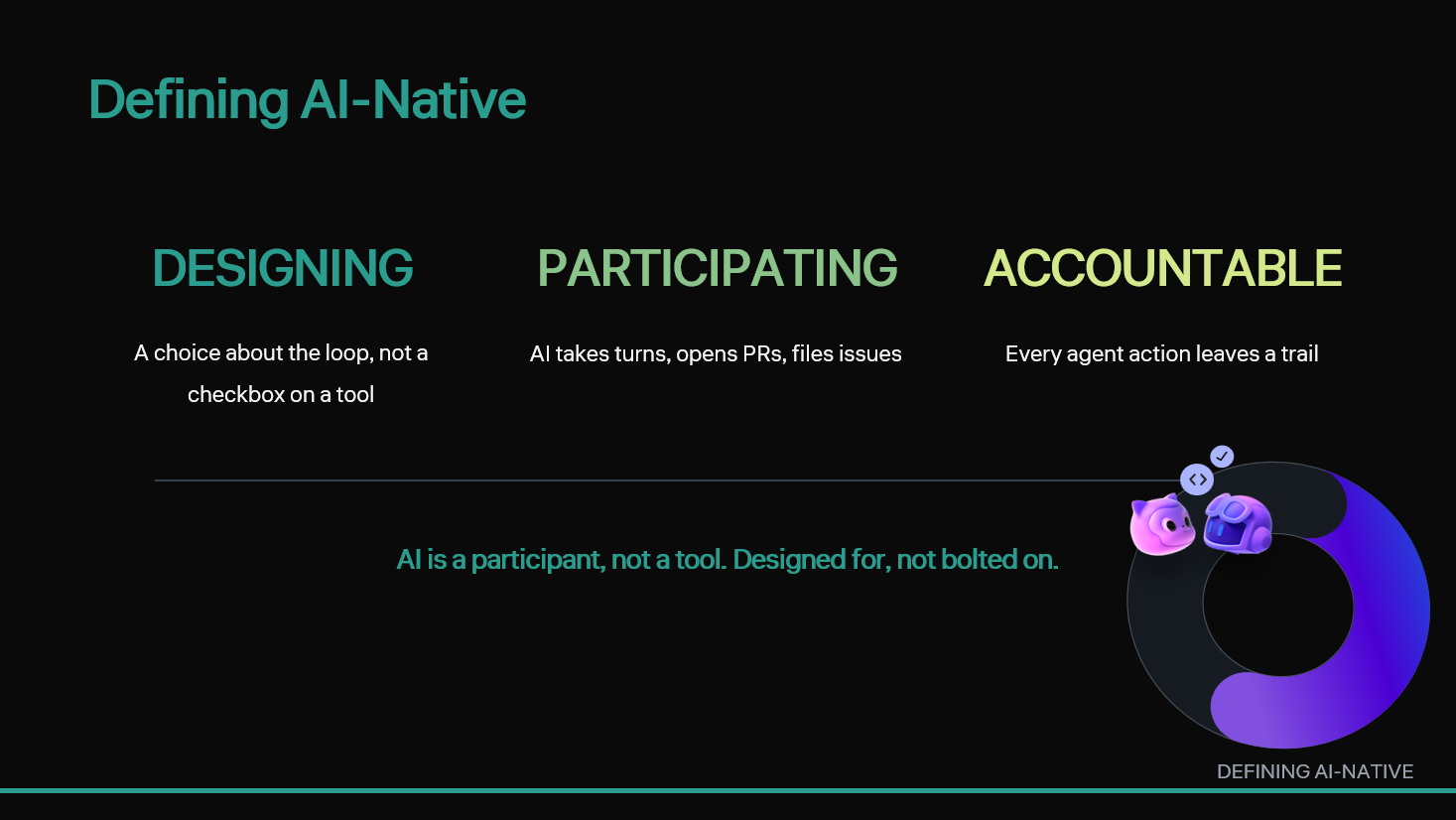
Defining AI-Native
A shared definition your team can use to align delivery decisions, controls, and accountability.
Why this chapter matters
A weak definition creates weak decisions. If AI-native simply means "we use AI tools," almost any team qualifies and the term loses operational value.
This chapter gives a stricter definition you can govern against.
Key points for your team
AI-native delivery means your system is intentionally designed so AI can participate in meaningful work while remaining observable, constrained, and accountable.
The definition has three parts:
- Designing: the loop is intentionally structured for human plus agent collaboration.
- Participating: AI influences non-trivial delivery stages, not just local edits.
- Accountable: all contributions can be traced, reviewed, and governed.
This is the practical test: if a contribution cannot be attributed and validated, it should not be treated as production-ready, no matter how impressive the output looks.
What to review with your team
Pressure-test your definition with concrete scenarios:
- Agent proposes architecture changes.
- Agent modifies infrastructure policy.
- Agent updates business-critical logic.
For each scenario, define required traces, required reviewers, and release conditions.
If the answers are inconsistent across teams, your definition is still conceptual and needs operational detail.
Put this into practice
Update your engineering handbook with an explicit AI-native definition and attach policy-level implications: evidence requirements, review ownership, and escalation paths.