The Six-Stage Loop
How to break delivery into explicit stages so quality and risk are managed on purpose.
Why this chapter matters
Without a clear loop, teams optimize the most visible stage: coding. But production outcomes are shaped by earlier decisions and later validations.
The six-stage loop makes the whole delivery system explicit so quality can be engineered end to end.
Key points for your team
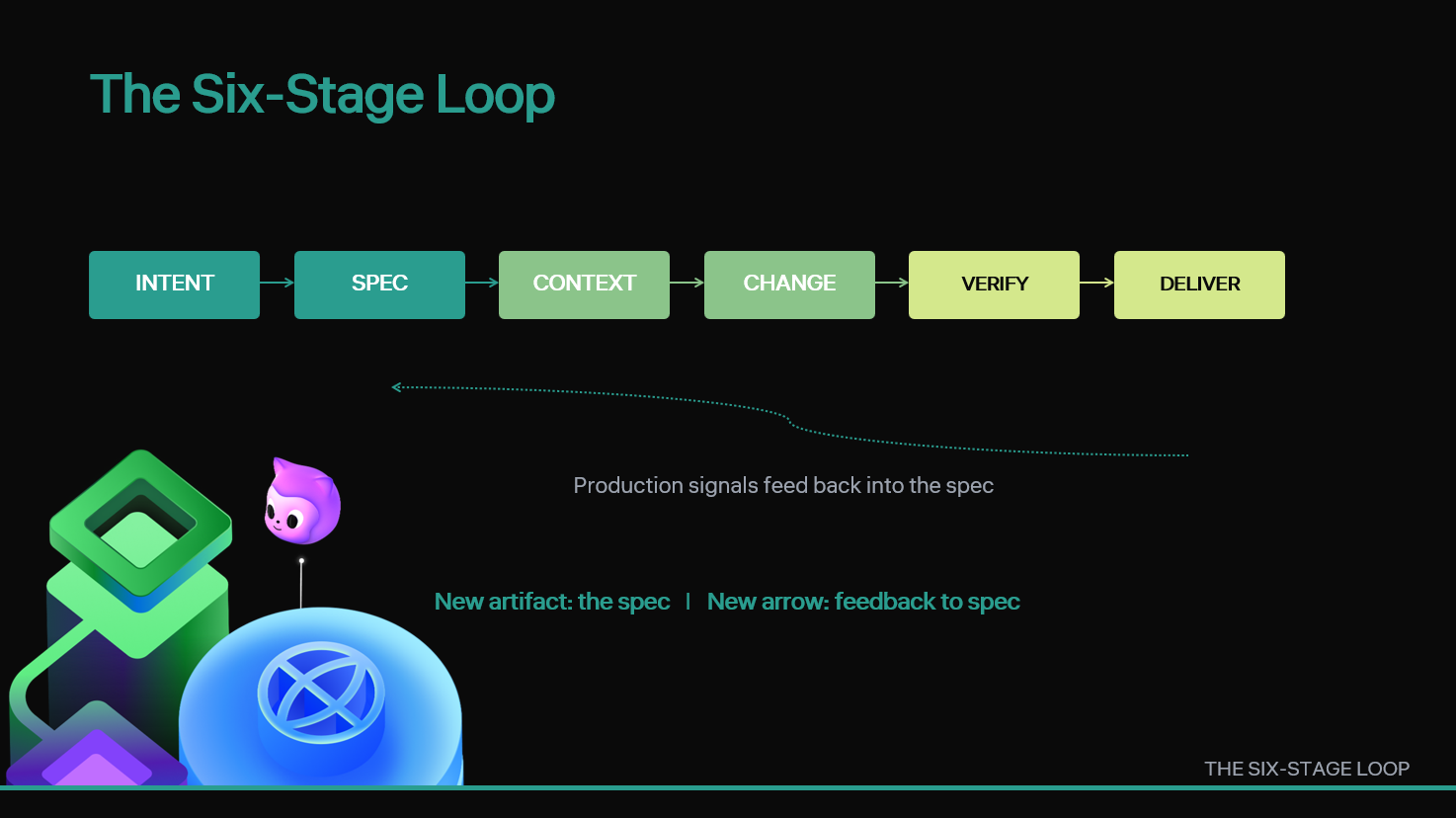
Think of the six stages as a control surface:
- Intent: what problem are we solving and why now?
- Spec: what exactly changes and what does success mean?
- Context: what constraints, tools, and prior decisions matter?
- Build: who implements what, and under which boundaries?
- Verify: what evidence proves quality, safety, and policy compliance?
- Operate and learn: what telemetry and outcomes feed back into intent?
Every stage should produce a durable artifact. Missing artifacts are where future incidents hide.
The most important addition in AI-native loops is feedback from operations back to intent and specification. That closes the learning cycle.
What to review with your team
Map one recent production change across all six stages and inspect:
- Which stages had strong artifacts?
- Which had only chat or verbal context?
- Where were quality gates ambiguous?
- Where did operational feedback fail to influence the next change?
This exercise typically reveals that coding was not the bottleneck. Alignment and verification were.
Put this into practice
For each of the six stages, define one required artifact and one required reviewer role. Start minimal, then increase rigor over time.