Four Modes, One Mission
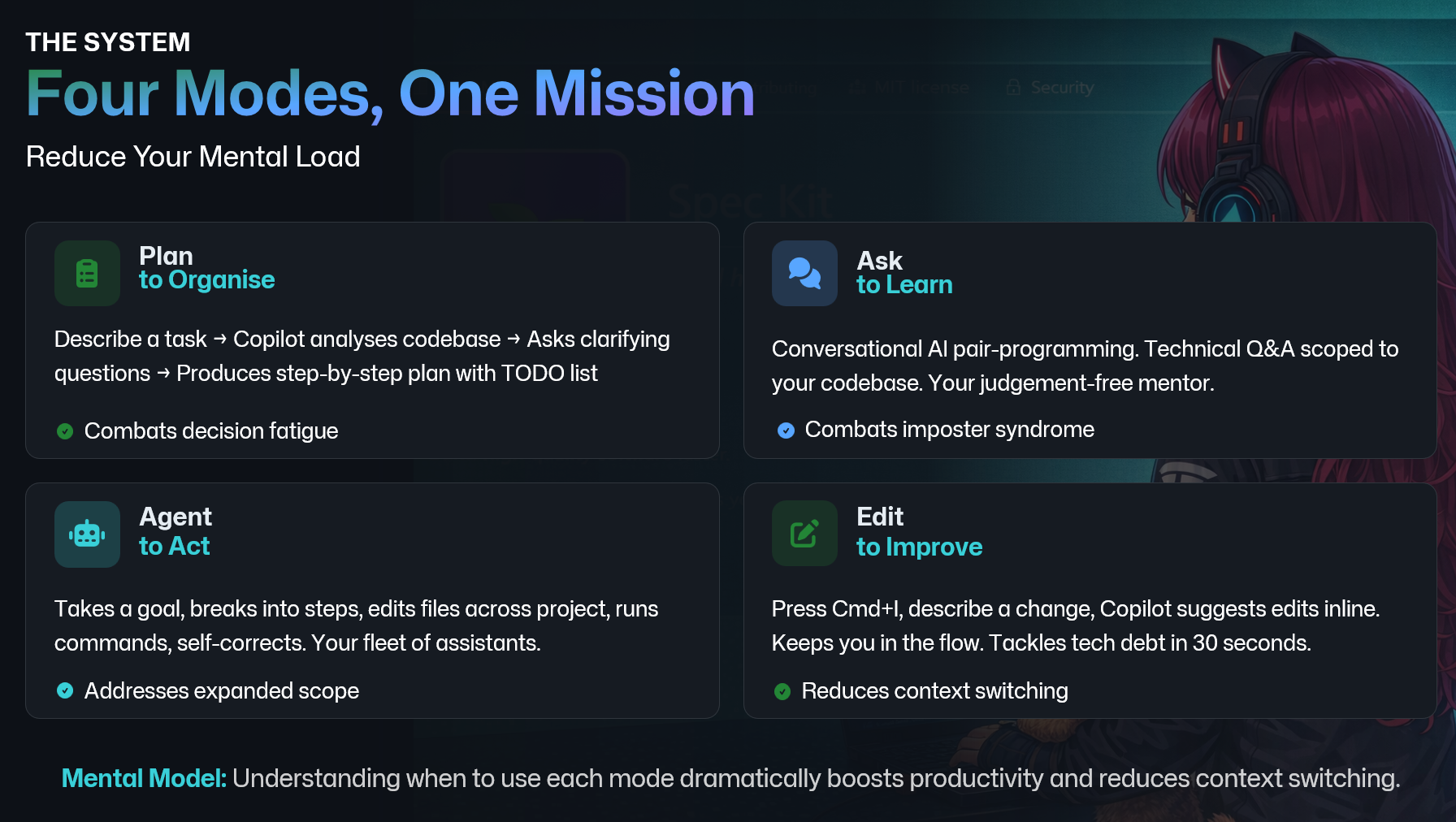
Now that we have rule zero, here’s the system I use to make AI actually reduce mental load instead of adding to it.
Four modes, one mission: reduce your mental load.
Mode one is Plan to Organise. This is where you describe the task, and the assistant helps you turn vague intent into a clear path: it analyses what you told it, asks clarifying questions, and produces a step by step plan with a TODO list. The win here is decision fatigue. You stop holding the whole problem in your head and you start working the plan.
Mode two is Ask to Learn. This is conversational pair programming and technical Q and A, ideally scoped to your codebase. It is your judgement free mentor. Use it when you are unsure, when you are learning a new stack, or when you want to sanity check your approach. The win here is it combats imposter syndrome because you can ask the question early, privately, and iterate until you actually understand.
Mode three is Agent to Act. This is when the scope expands beyond a single file. You give a goal, and the agent breaks it into steps, edits across the project, runs commands, and self corrects. The win is that it addresses expanded scope without you context switching across twenty files and losing the thread.
Mode four is Edit to Improve. This is the quick one. You already know what you want. You just want the change done cleanly, inline, without breaking flow. Use it for refactors, naming, extracting functions, tightening up error handling, improving tests, or reducing tech debt in small chunks. The win is fewer interruptions and less context switching.
The mental model is the key point: do not just ‘use AI.’ Choose the mode that matches the moment. When the mode matches the task, you get speed and quality. When the mode is wrong, you get more noise, more review burden, and more burnout.
Next, I’ll show you how to prompt for each mode so you get reliable results and you stay in control.