The Right Way to Use AI
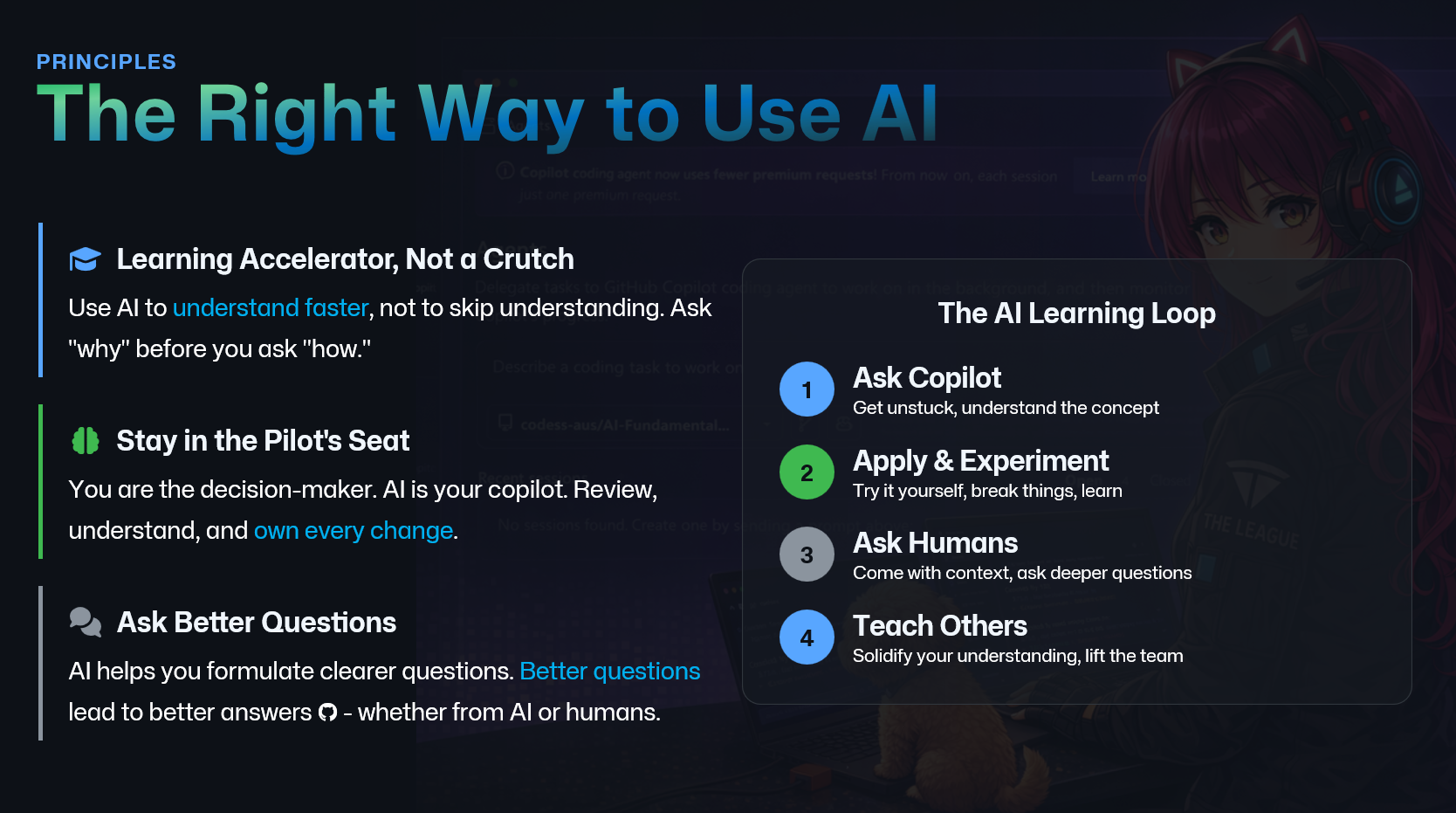
After all the demos, I want to land on principles, because the real risk with AI is not that it is powerful. It is that it is easy to use poorly.
So this slide is my checklist for the right way to use AI.
First: treat AI as a learning accelerator, not a crutch.
Use it to understand faster, not to skip understanding. A practical habit is to ask ‘why’ before you ask ‘how.’ Why does this pattern exist, why is this bug happening, why is this tradeoff preferred here. Once you have the why, the how becomes safer.
Second: stay in the pilot’s seat.
You are the decision maker. AI is your copilot. That means you review, you understand, and you own every change. If you cannot explain what just changed, you should not ship it.
Third: ask better questions.
This is the theme of the whole talk. AI can help you formulate clearer questions, and clearer questions produce better answers, whether they come from AI or humans. The quality of the output is strongly shaped by the clarity of the input.
On the right is the loop I recommend, because it prevents dependence and builds confidence.
Step one: ask Copilot. Get unstuck and get the concept.
Step two: apply and experiment. Try it yourself. Break it in a safe environment. That is where the learning sticks.
Step three: ask humans, but come with context. Bring what you tried, what you observed, and what you still do not understand. That makes mentorship cheaper and higher quality.
Step four: teach others. If you can explain it, you own it. And it lifts the entire team.
This is how AI reduces burnout without lowering standards: it makes learning and progress cheaper, while keeping ownership and judgment exactly where it belongs, with you.