Rule Zero - You Own the Code
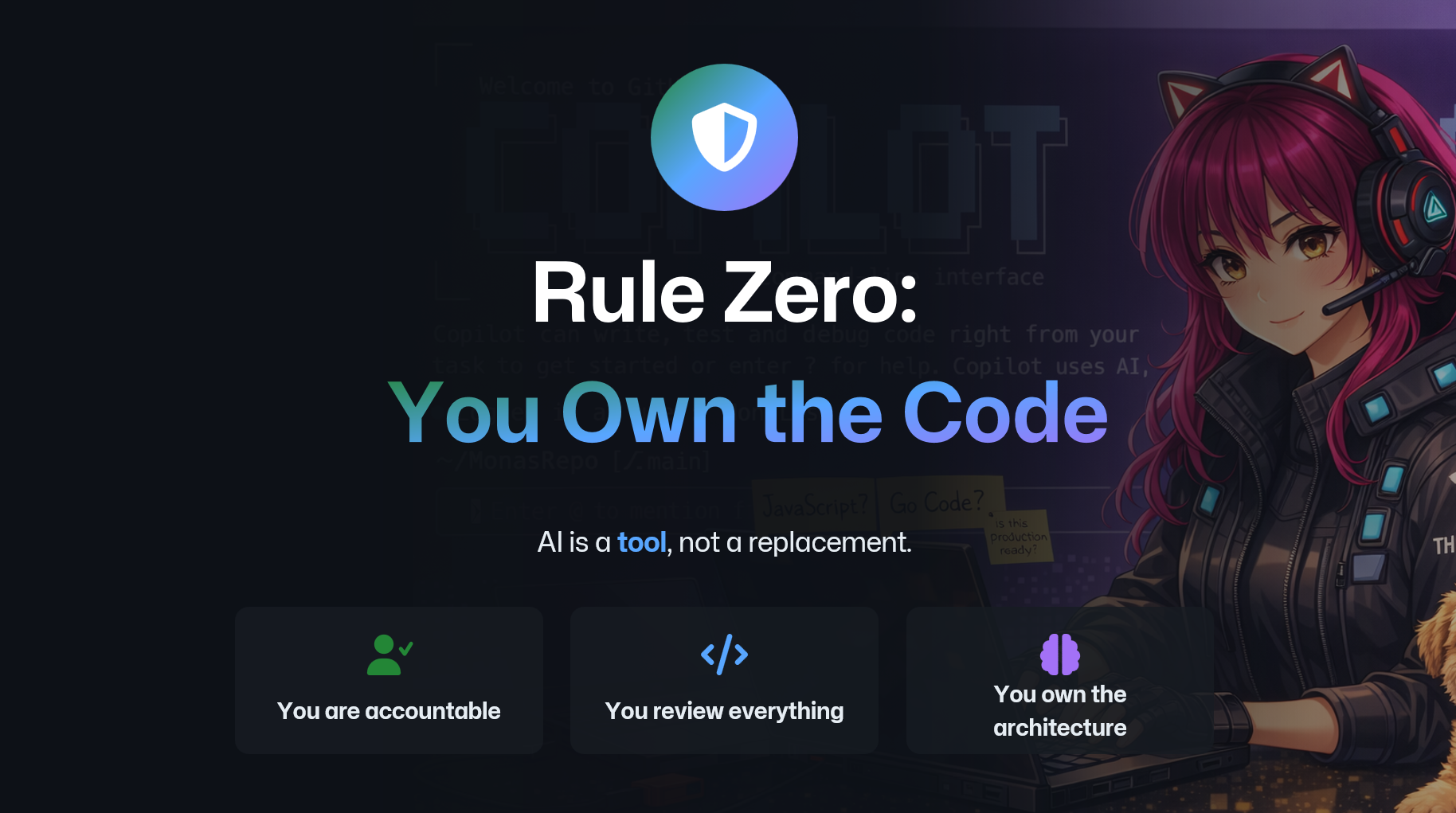
Before we go any further, we need one grounding principle. Rule zero: you own the code.
AI can help you move faster, but it cannot take responsibility for what ships. If it introduces a bug, a security issue, a licensing problem, or a design mess, it does not matter that the suggestion came from a tool. The accountability still sits with us.
So when I say ‘AI is a tool, not a replacement,’ I mean three practical things.
First: you are accountable. You are the engineer of record. You decide what goes in, what stays out, and what gets rolled back.
Second: you review everything. Treat AI output like a confident junior who works at infinite speed. Useful, often right, sometimes wildly wrong, and occasionally wrong in a way that looks convincing. Your job is to verify: tests, edge cases, performance, security, and whether it actually matches the requirement.
Third: you own the architecture. AI is great at generating local code. It is not great at long term system tradeoffs unless you provide strong constraints. You decide the boundaries, the patterns, the data flow, and what ‘good’ looks like in this codebase.
If we keep rule zero in mind, we can use AI aggressively and responsibly. It becomes empowering instead of risky. Now let’s talk about how to ask for help from AI in a way that improves quality instead of just producing more code.