The Mentor Loop
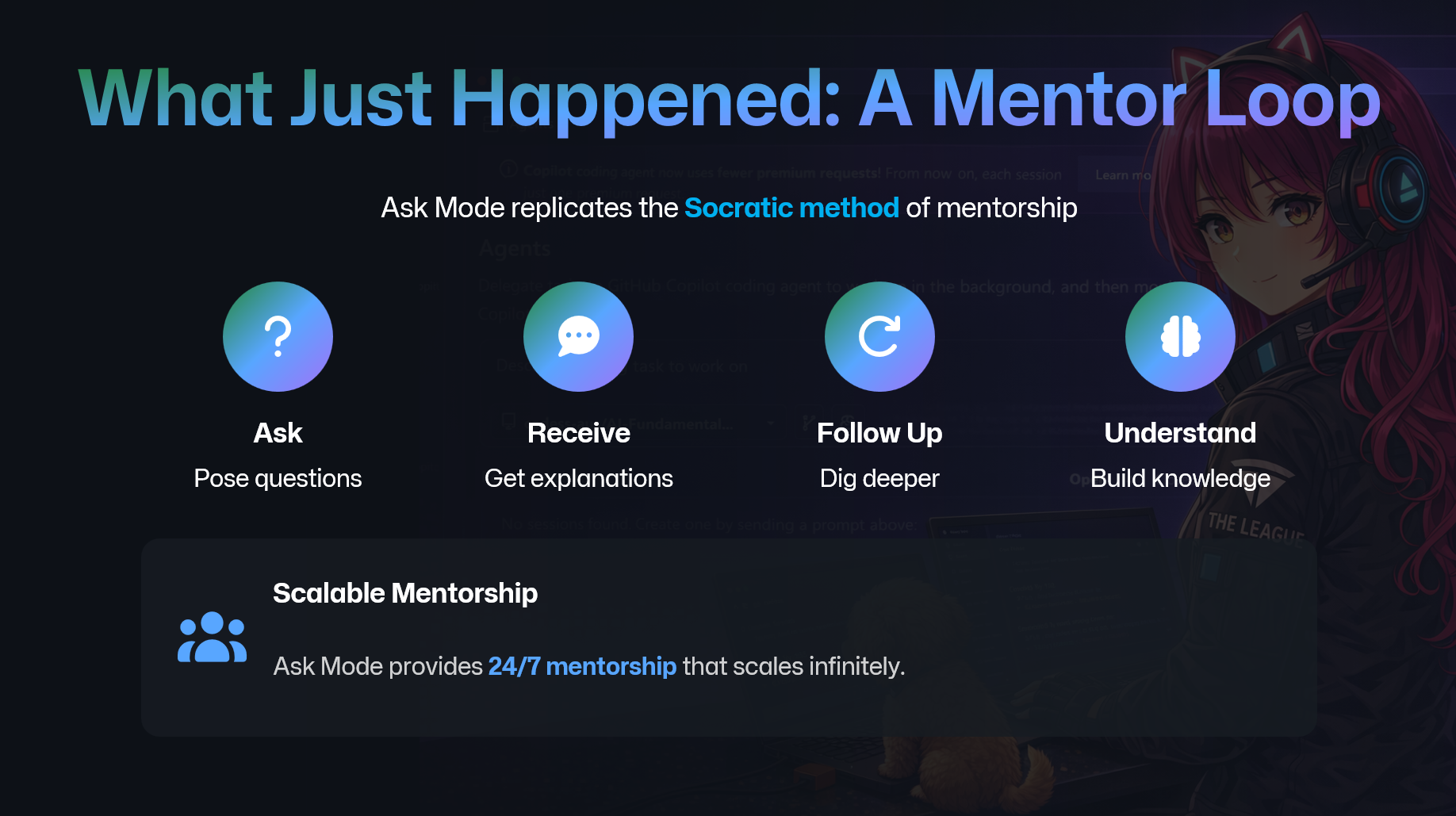
So, what just happened in that demo?
What we did was not ‘ask for an answer.’ We ran a mentor loop.
Ask Mode works best when you treat it like Socratic mentorship. Not just ‘tell me the fix,’ but a loop that helps you build the mental model.
Step one: Ask. Pose a clear question about what you are seeing. ‘This behavior surprised me. What is going on?’ Step two: Receive. Get an explanation in plain language, ideally with a small example. Step three: Follow up. This is the most important part. Dig deeper with questions like ‘what would happen if…’, ‘how can I detect this earlier…’, ‘what are the safe patterns…’, ‘how do we test for it…’. Step four: Understand. The goal is that you can now predict the behavior, not just patch it. That is knowledge you can reuse.
And this is why it reduces burnout. It turns the scary moment of ‘I’m stuck and I should already know this’ into a structured learning process that is private, fast, and repeatable.
The big takeaway is at the bottom: scalable mentorship. Ask Mode can provide support 24/7, and it scales, which means your seniors are not the only safety net. They can focus on the hard design work, and everyone else can get unstuck without waiting or feeling judged.
Next, we’ll use this same loop on a few more real world questions, so you can see how to prompt for understanding, not dependency.