The Burnout Epidemic
Before we talk about tactics, we need to name the problem.
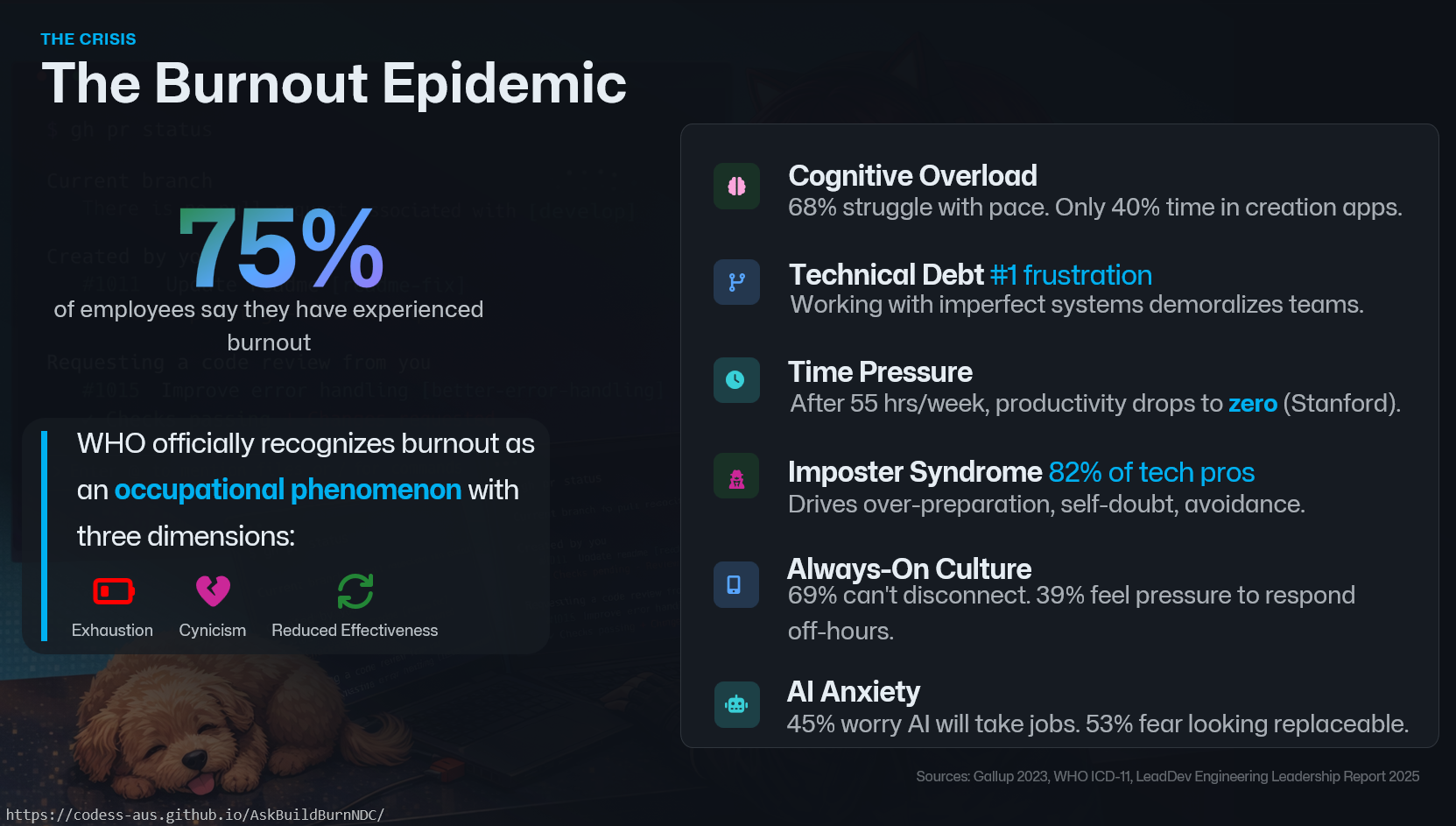
This is the crisis: burnout is not rare, it is common. This slide cites 76 percent of employees experiencing burnout. Even if your number is lower on your team, the direction is clear. People are tired, and it shows up in quality, retention, and how safe it feels to take risks.
The World Health Organization recognizes burnout as an occupational phenomenon, not a personal failure. And they describe three dimensions: exhaustion, cynicism, and reduced effectiveness. That matters because it gives us a shared language. Instead of saying ‘I’m not coping,’ we can say ‘I’m showing signs in these dimensions,’ which makes it easier to respond earlier.
On the right are the usual suspects in tech.
Cognitive overload is the constant task switching, constant decisions, and constant interruptions. It is not that the work is hard, it is that it never stops being loud.
Technical debt is often the number one frustration because it turns simple work into detective work, and it creates a steady drip of small failures that demoralize teams.
Time pressure is the trap where we try to sprint forever. After a certain point, more hours do not produce more outcomes, they produce more mistakes.
Imposter syndrome is the hidden tax. It drives over preparation, avoidance, and the feeling that you have to prove yourself every day.
Always on culture is when the workday never really ends. Even when you are not working, you are on call emotionally.
And now there is AI anxiety, which adds uncertainty about skills, value, and job security on top of everything else.
So if you have felt any of this, you are not broken. You are responding normally to an abnormal load.
The rest of this talk is about one lever that helps across all of these: asking better questions to reduce uncertainty, reduce rework, and make the work feel more controllable. That is where ‘ask more’ becomes a burnout strategy, not just a communication tip.