Governance
How to do AI governance without becoming the team everyone routes around.
The two failure modes
Most AI governance programs fail in one of two ways:
- Too heavy. Every feature requires a long, heavy review. Teams route around you. Shadow AI flourishes.
- Too light. Anyone can ship anything. Eventually something embarrassing happens. The pendulum swings to (1).
The goal is the middle: light-touch, high-trust, well-instrumented.
A starter governance model
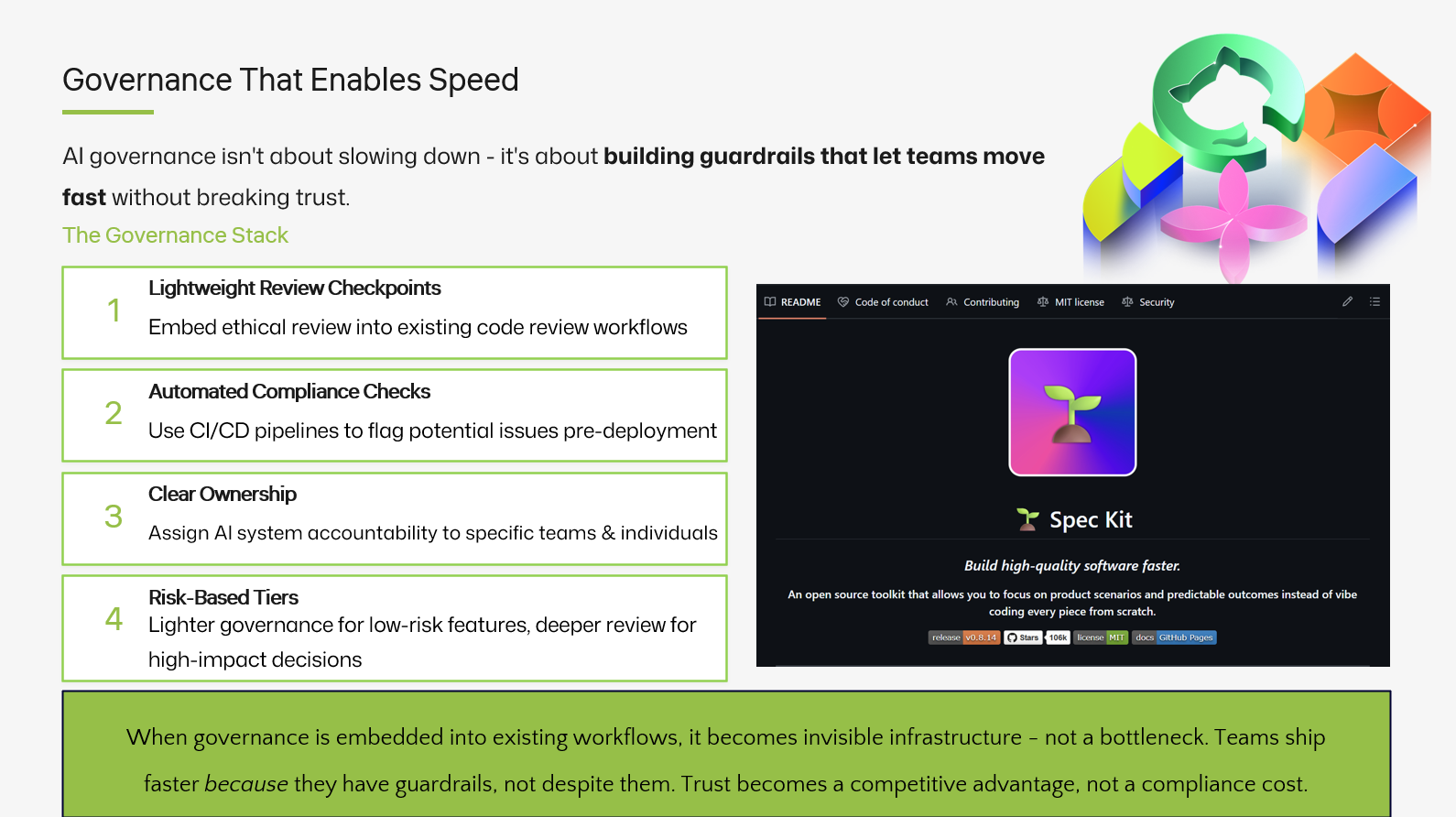
- A short standard. Two pages, not eighty. Plain English.
- A tiered risk model. Low / Medium / High based on blast radius, data sensitivity, and reversibility. The tier determines the rigor.
- A self-serve checklist for Low and Medium. A real review for High.
- A central inventory. You can't govern what you can't see. Every AI feature, with an owner, a tier, and a link to its evals.
- A no-blame reporting channel for AI incidents and near-misses. Treat it like security.
Make the right thing the easy thing
The most successful governance teams don't gate, they enable. They ship:
- A blessed prompt library.
- A blessed eval harness.
- A blessed agent framework with safety defaults on.
- A template repo that has all of the above wired up.
When the paved road is the safest road, governance is just "use the paved road."