title: "12 · Explainability" description: ""Because the model said so" is not an answer. Designing systems that can tell you why."
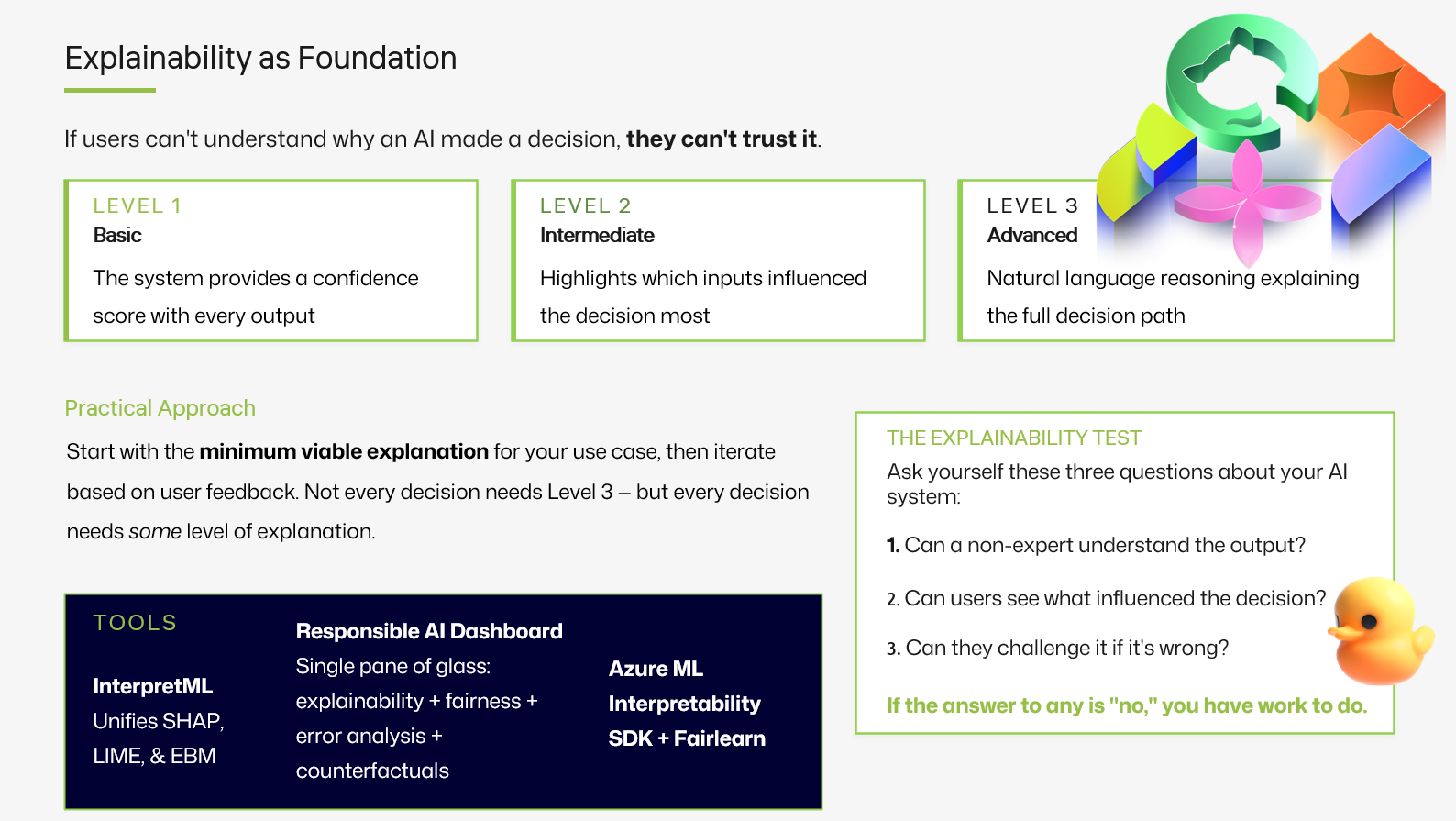
Explainability
"Because the model said so" is not an answer. Designing systems that can tell you why.
Explanation is a product surface
Explainability isn't a research problem you solve once and tick off. It's a surface in your product that you have to design, build and maintain like any other.
The good news: you don't need a PhD in interpretability to do it well. You need to be honest about what you can show.
A layered approach
Think of explainability as three concentric layers:
- What it did, the action, the inputs, the output, timestamped.
- Why it chose that, the prompt, the retrieved context, the tools called, the confidence.
- How the model works at all, the model card, the training data summary, the known limitations.
Most products only ship layer 1. The trust gap is layers 2 and 3.
Concrete things you can ship this quarter
- Citation chips next to AI-generated answers, linking to the source documents.
- "Show reasoning" disclosure that surfaces the plan or chain-of-thought summary.
- A model card linked from every AI feature, what it is, what it isn't, who owns it.
- An audit log the user can view, not just the platform team.
If you can't explain it to the user, you can't expect them to trust it. And if you can't explain it to yourself, you shouldn't have shipped it.