GitHub as the Holistic Control Plane#
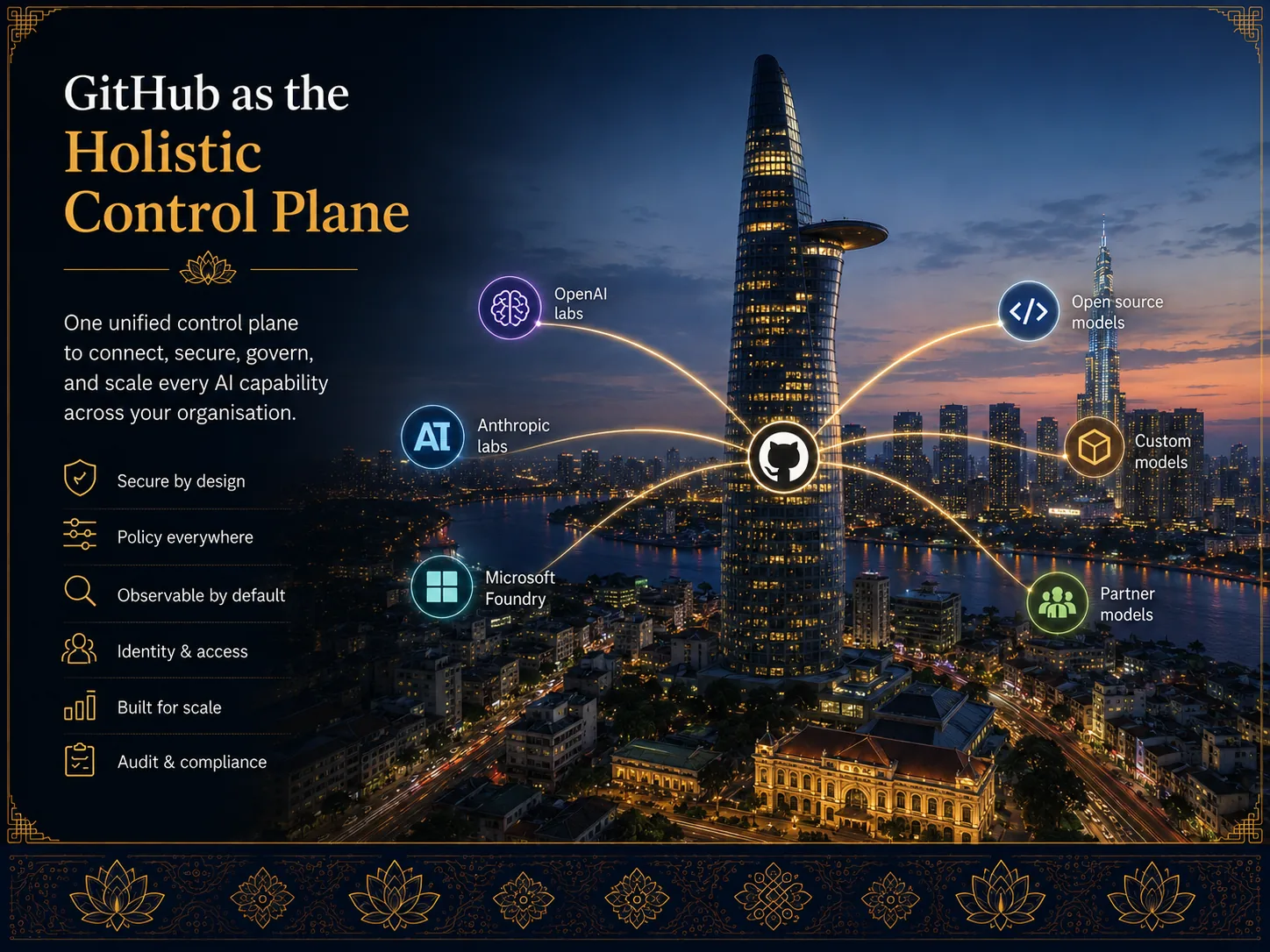
Frontier labs innovate; you need one place that governs all of it#
Model providers - OpenAI, Anthropic, Microsoft Foundry, the open-source ecosystem, and specialised partner models - are innovating fast and independently. That's good for capability, but it's a governance problem if every team picks a different model with its own access pattern, its own audit trail (or lack of one), and its own security posture. The answer isn't picking a single model and freezing it - it's putting a consistent control plane underneath all of them.
What "control plane" means in practice#
GitHub already holds the primitives that make it a natural control plane for agentic work, independent of which model is doing the reasoning underneath:
- Secure by design - identity, authentication and secret handling are already centralised in GitHub; agents authenticate the same way any other automation does, through scoped tokens and app permissions, not shared credentials.
- Policy everywhere - organisation-level rulesets, required reviewers, and CODEOWNERS apply uniformly whether the diff came from a human, a Copilot coding agent, or a custom agent built on a different model.
- Observable by default - pull requests, checks, and (for enterprise customers) the agent control plane give a single place to see what agents did, when, and under whose approval.
- Identity and access - GitHub Apps and fine-grained permissions mean an agent's blast radius can be scoped precisely (read this repo, open PRs here, never touch that path) rather than granted broad access by default.
- Built for scale - the same platform that runs CI for thousands of repositories is the one coordinating agent-authored changes across all of them.
- Audit and compliance - every approval, every required check, every merge is already logged as part of the normal Git and pull request history; agentic work inherits that trail rather than needing a parallel system.
Why model-agnostic governance matters more than model choice#
Teams change models. New frontier models will keep shipping, and different tasks suit different models - a fast, cheap model for a docs agent; a stronger reasoning model for an architect or security agent (see Chapter 5). If your governance is wired to a specific vendor's dashboard rather than your own platform, every model change becomes a governance re-implementation project. Anchoring policy, review, and audit in GitHub (or your existing Azure DevOps environment, applying the same principle) means the control plane stays constant even as the agents running on top of it evolve.
Exercise: map your current agent footprint against the control plane#
List every AI tool or agent currently touching your codebase - IDE assistants, coding agents, custom bots, CI-integrated tools. For each, answer: is its access scoped with least privilege? Does its activity show up in your existing audit trail? Would a required-reviewer rule catch a bad change from it today? Any "no" is a governance gap to close before adding more agents to the mix.
Further reading#
- Enterprise AI controls & the agent control plane are in public preview - GitHub Changelog
- About rulesets - GitHub Docs
- Foundations of Agentic AI in GitHub - Microsoft Learn