Rule Zero in Practice: Accountability#
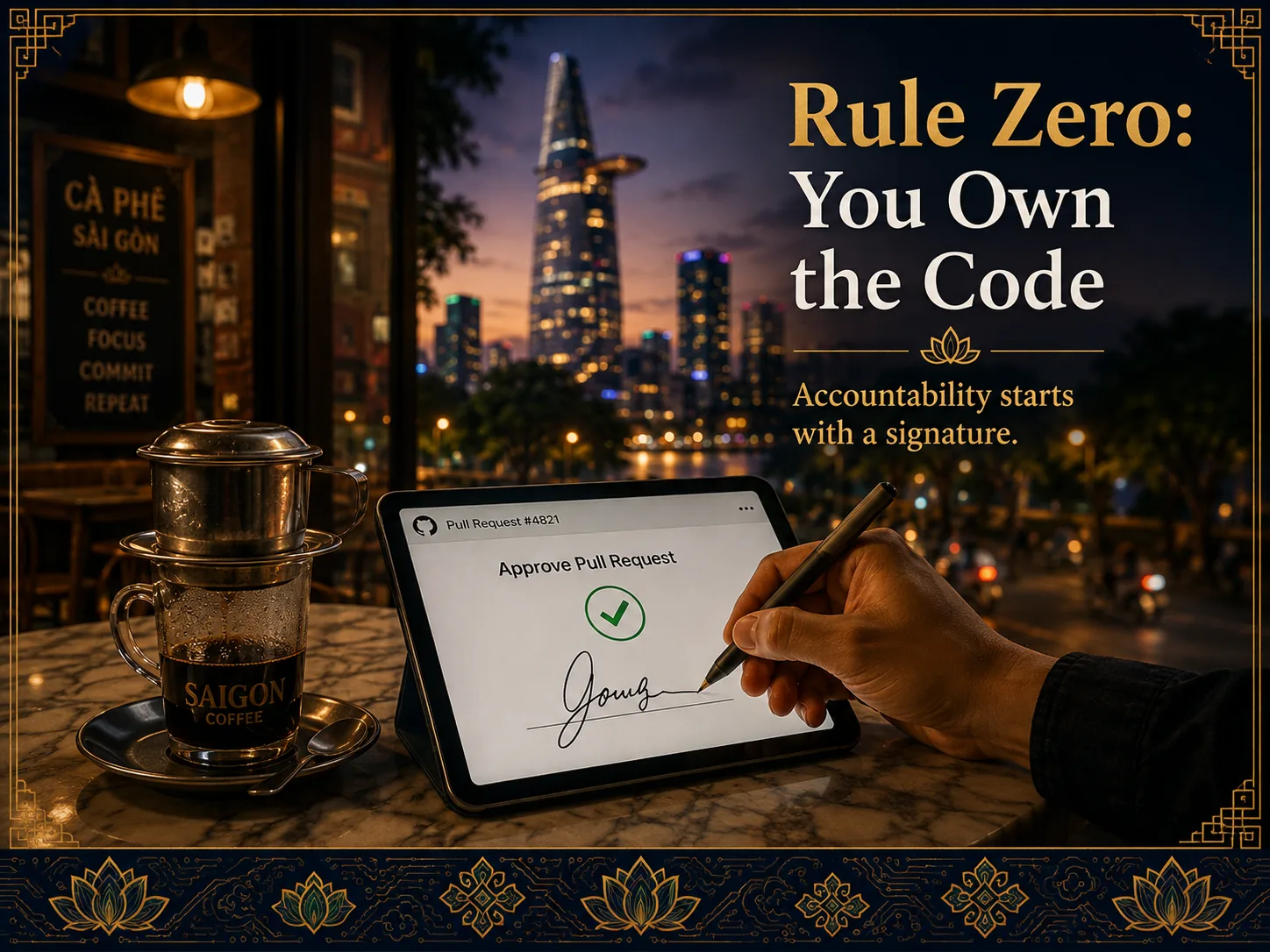
"I checked the diff. I own this merge."#
That line - used later in the demo in Chapter 7 - is the whole chapter in one sentence. Approving a pull request is a signature. In GitHub, that signature is literally attached to your identity, timestamped, and permanent in the repository's history. Rule Zero in practice means treating that click with the same weight as a physical signature on a document you'd be asked to defend later.
What a real review of agent-authored work looks like#
A review that only checks "does it look plausible" is not a review - it's the exact bias Chapter 2 warned about. A review that actually holds up under Rule Zero includes:
- Read the diff, not the summary. Agent-generated pull request descriptions can be a good starting point, but they describe intent - the diff is the ground truth of what will run in production.
- Trace claims to sources. If the change references a library behaviour, a metric, or an external fact (a version number, a deprecation date, a security advisory), verify it against the primary source before approving. This is precisely the gap that let fabricated case studies slip through in the anecdote from Chapter 2 - no one asked "where does this number come from?"
- Check the blast radius, not just the lines changed. A five-line change to a shared auth middleware is a bigger review than a two-hundred-line change to a single isolated test file.
- Confirm CI actually ran and passed - don't approve on a stale or skipped check. GitHub surfaces required status checks directly on the PR; use them.
- Use a second agent as a first pass, not a substitute. An agent reviewer (see Chapter 5) is excellent at catching style violations, missing tests, or obvious logic errors quickly - but its approval is not a merge gate on its own. It reduces the human's load, not their accountability.
Structuring this in GitHub#
- Turn on Copilot code review as an automatic first-pass reviewer on pull requests, so obvious issues surface before a human even opens the diff.
- Require a human approval in addition to any bot/agent review via branch protection or rulesets - an agent review should never count as the required reviewer on its own for anything reaching production.
- Use PR templates that force the author (human or agent) to answer "what did you verify, and how" before a reviewer even starts - this shifts some of the sourcing work earlier in the pipeline.
- Keep an audit trail: who approved, what checks were required, what the agent's session/tooling context was. The enterprise agent control plane is designed exactly for this - a consolidated, queryable record of agent activity across an organisation.
Exercise: the five-minute source check
Take the last pull request you approved that referenced any external fact, library behaviour, or number (a version, a percentage, a claimed limit). Time yourself finding the primary source for that fact. If it takes longer than five minutes, or you can't find one, add "cite your source" as a required field in your PR template today.
Further reading#
- Using GitHub Copilot code review - GitHub Docs
- Enterprise AI controls & the agent control plane are in public preview - GitHub Changelog
- About rulesets - GitHub Docs