Agentic Workflows: The Fleet and The Squad#
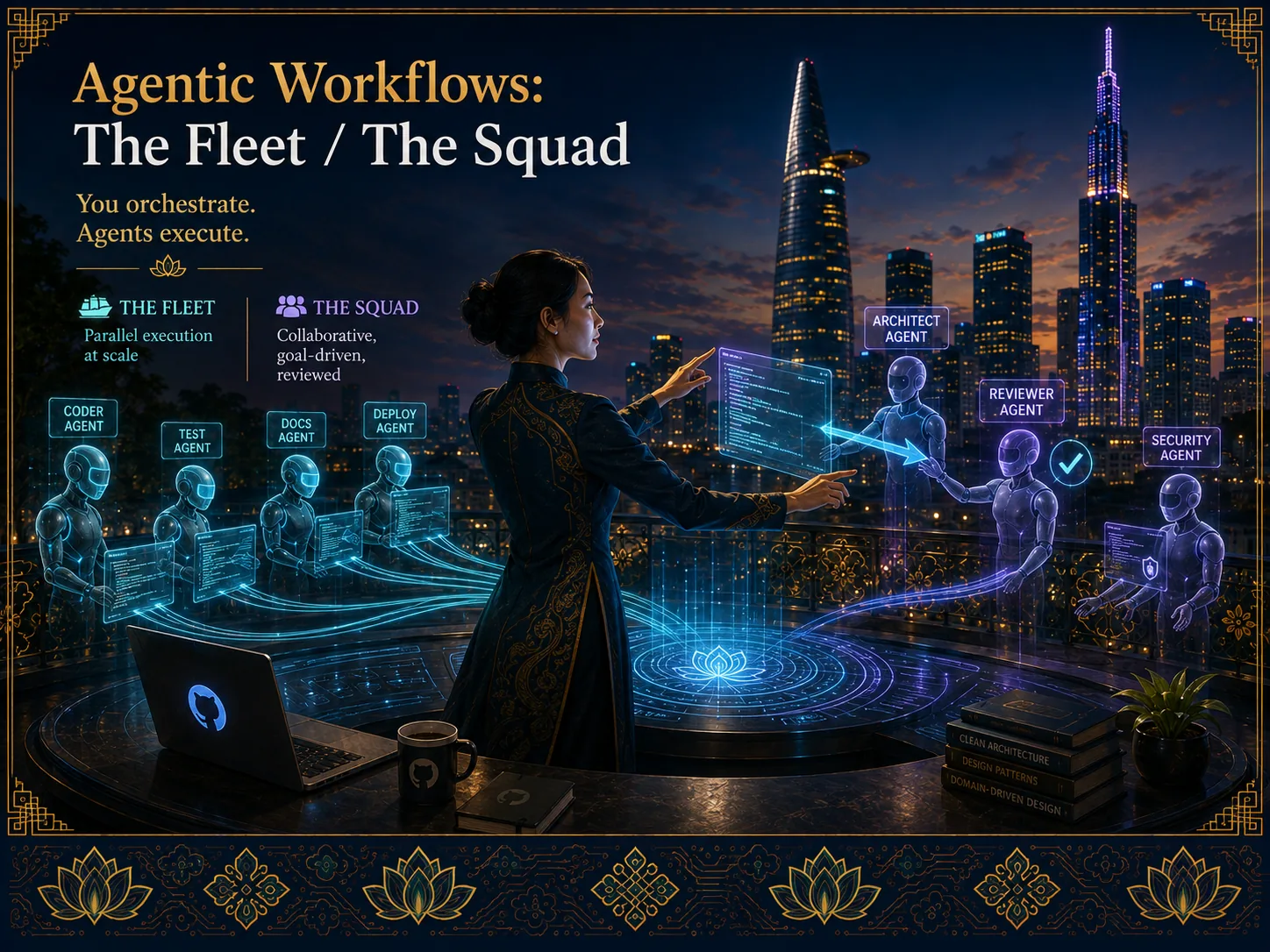
Two patterns, one principle: you orchestrate, agents execute#
Agentic engineering doesn't mean one assistant in one editor tab. In practice it splits into two complementary operating models, and most mature teams end up using both depending on the shape of the work.
The Fleet - parallel execution at scale#
The Fleet pattern runs multiple specialised agents in parallel, each responsible for a distinct concern: a coder agent, a test agent, a docs agent, a deploy agent. Each works its own lane concurrently against the same task, and the human orchestrator merges their outputs into a coherent change. This is the right pattern when the work decomposes cleanly into independent tracks - implementation, tests, and documentation for the same feature can genuinely proceed in parallel once the interface is agreed.
The failure mode to design against: parallel agents drifting out of sync with each other (the docs agent describing behaviour the coder agent hasn't implemented yet, or vice versa). Keep the shared contract - the issue, the interface, the acceptance criteria - as the single source of truth all fleet members read from.
The Squad - collaborative, goal-driven, reviewed#
The Squad pattern is sequential and layered: an architect agent proposes an approach, a coder or coding agent implements it, a reviewer agent checks the implementation, and a security agent screens for risk before it ever reaches a human. This is the Rubber Duck pattern in its explicit form - one agent's output is reviewed by a second agent before a human sees it, catching the class of error a rushed human reviewer might miss on a first pass, without removing the human from the loop entirely.
Squads suit work with real risk of subtle error: anything touching authentication, data migrations, financial calculations, or anything where "looks right" and "is right" diverge easily.
Why "Rubber Duck" is the right name for it#
Rubber duck debugging is the practice of explaining your code out loud to an inanimate object to force yourself to notice gaps in your own reasoning. The agentic version formalises that: instead of a human narrating to a toy, a second agent is given the first agent's diff and asked to find problems with it, before a human's attention - the scarcest resource in the pipeline - is spent. It doesn't replace human review (see Chapter 3); it raises the quality of what reaches the human, so their review time is spent on judgement calls rather than catching typos and obvious omissions.
Token optimisation: why architecture here isn't free#
Every agent in a Fleet or Squad consumes tokens, and cost/latency scale with how much context each agent is re-fed. Practical patterns that keep multi-agent workflows efficient:
- Scope context tightly per agent. A docs agent doesn't need the full test suite in its context window; a reviewer agent needs the diff and the relevant surrounding code, not the entire repository history.
- Cache and reuse shared context (the issue, the architecture decision, the style guide) rather than re-sending it to every agent in the chain.
- Prefer smaller, faster models for narrow, well-defined sub-tasks (linting, formatting checks, doc generation) and reserve larger models for the steps that need genuine reasoning (architecture proposals, security review).
- Set explicit turn/step budgets per agent so a stuck agent fails fast and hands back to a human instead of looping expensively.
Exercise: map your next feature to Fleet or Squad#
Take a feature currently in your backlog. Sketch which parts decompose into independent, parallel tracks (Fleet) and which parts have a strict dependency chain with real risk of subtle error (Squad). Most features are a mix - identify the boundary where your Fleet's outputs need to pass through a Squad-style review gate before merge.
Further reading#
- About Copilot coding agent - GitHub Docs
- Using GitHub Copilot code review - GitHub Docs
- Agentic DevOps in action: reimagining every phase of the developer lifecycle - Microsoft Developer Blog