A Redesign, Not a Bolt-On#
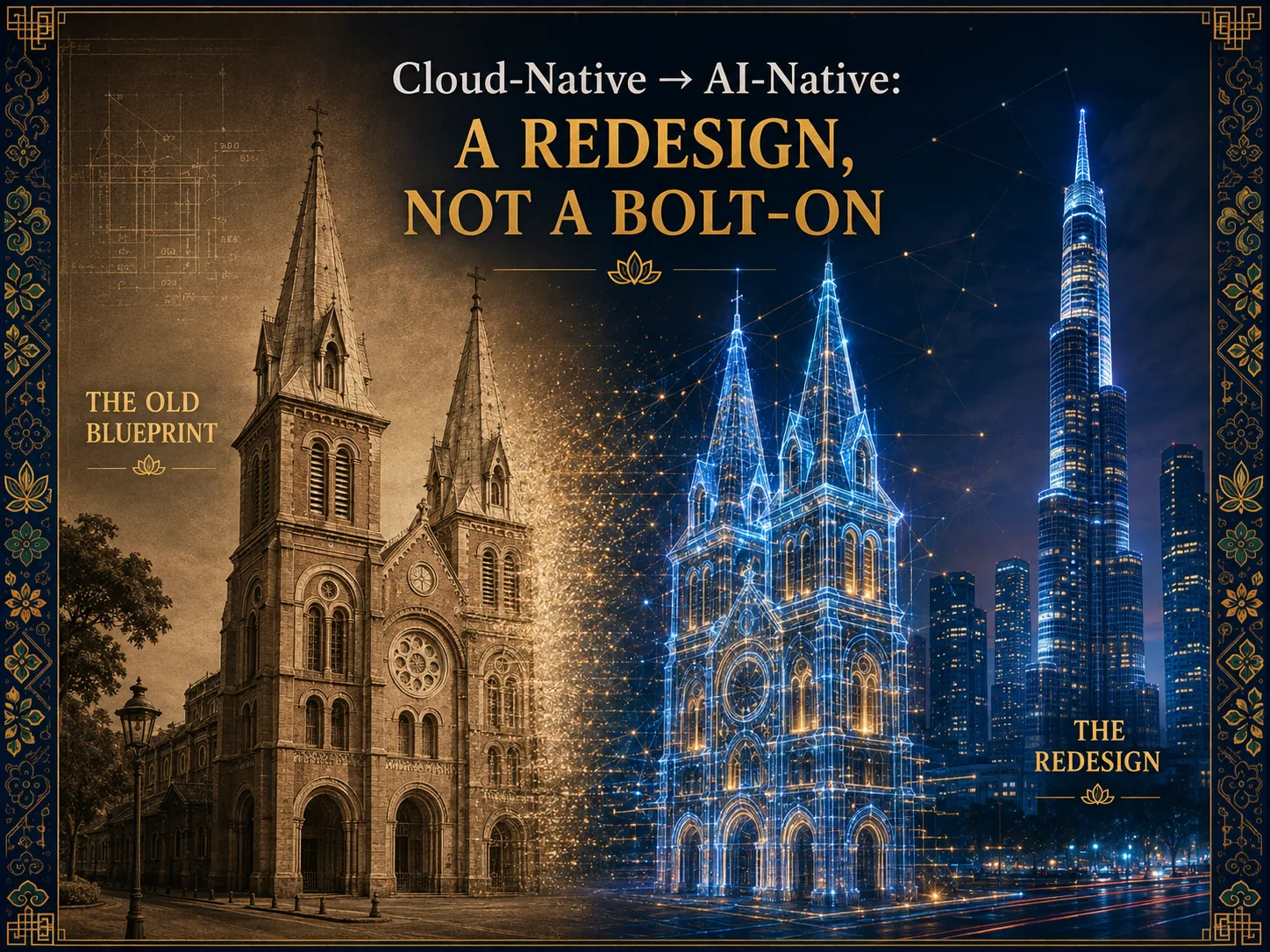
The analogy: running Docker on a mainframe#
Cloud-native didn't happen because someone put a container runtime on top of a data centre built for monoliths. It happened because teams rethought deployment, scaling, and failure handling from first principles - twelve-factor apps, immutable infrastructure, declarative config, and a control loop that reconciles desired state against actual state.
AI-native is the same kind of shift, one layer up the stack. Bolting a chat assistant onto an unchanged SDLC is the equivalent of running a single container on a mainframe: technically possible, but it captures none of the benefit and inherits all of the old constraints - manual gatekeeping at every step, review processes designed for a world where every line of a diff was typed by a human who could explain their own reasoning without being asked.
An AI-native SDLC redesigns the unit of work, not just the tool. The unit of work stops being "a developer opens an IDE" and becomes "a scoped, reviewable task is assigned to an agent, with a human accountable for the outcome."
What actually needs to change#
| Cloud-native SDLC | AI-native SDLC |
|---|---|
| CI runs on human-authored commits | CI runs on agent-authored commits, at higher frequency and volume |
| Code review is a single human gate | Code review becomes multi-stage: agent self-check → agent reviewer → human approver |
| Backlog grooming assumes human capacity is the constraint | Backlog grooming assumes governance and review capacity is the constraint |
| Branch protection exists to catch human mistakes | Branch protection and required reviews exist to catch agent hallucination and human rubber-stamping |
| Observability tracks deploys and incidents | Observability also tracks agent sessions, prompts, tool calls, and policy decisions |
None of this throws away cloud-native discipline - GitOps, trunk-based development, automated testing, and policy-as-code all still apply. It adds a layer: treat every agent as a contributor with its own identity, permissions, and audit trail, exactly the way you'd onboard a new engineer, except the onboarding is config instead of a laptop.
Where GitHub already gives you the primitives#
You do not need to invent this from scratch. The redesign leans on primitives that already exist in GitHub and Azure DevOps:
- Repository rulesets and branch protection - enforce required reviews and status checks on every branch, regardless of whether the author is human or agent. See About rulesets.
- CODEOWNERS - route agent-authored changes in sensitive paths (auth, infra, payments) to the humans who must sign off. See About code owners.
- GitHub Copilot coding agent - an agent that works from an assigned issue, opens a draft pull request, and iterates against your existing CI. See About Copilot coding agent.
- Agent control plane (enterprise) - a consolidated, auditable view of agent activity across an organisation. See the GitHub Changelog: Enterprise AI controls & the agent control plane.
Exercise: audit your SDLC for bolt-on thinking#
Pick one recent pull request in your team's main repository and answer honestly:
- Would your current branch protection rules stop a plausible-looking but factually wrong change from merging, if a human reviewer was tired and skimmed it?
- If an agent had authored that PR instead of a person, is there anything in your process today that would treat it differently - more scrutiny, a different reviewer, a narrower set of allowed paths?
- Do you have a CODEOWNERS entry for every path where a wrong change would be expensive to undo (migrations, IAM policy, deployment manifests)?
If the answer to (2) is "no, nothing would change," that's a signal your SDLC is still bolt-on: the tooling changed, the guardrails didn't.
Further reading#
- About rulesets - GitHub Docs
- About code owners - GitHub Docs
- Agentic DevOps: evolving software development with GitHub Copilot and Microsoft Azure - Microsoft Azure Blog
- Foundations of Agentic AI in GitHub - Microsoft Learn