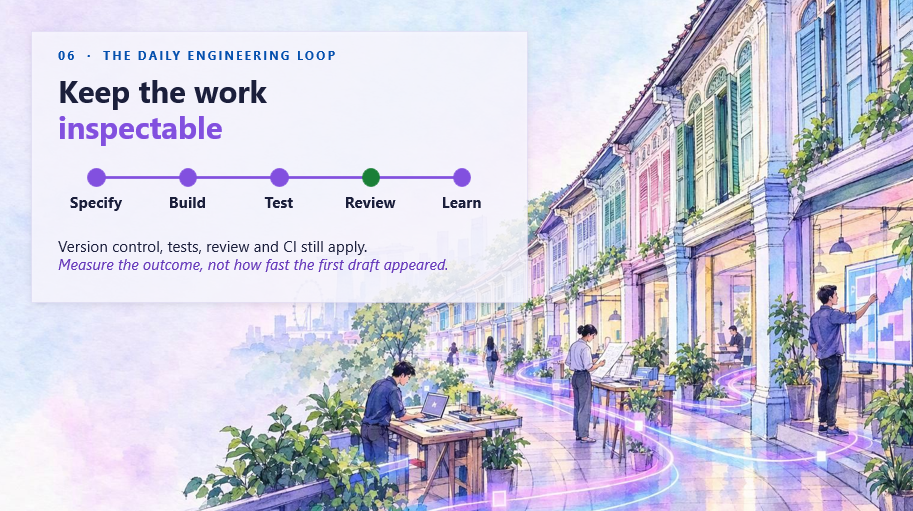
06 · Keep the work inspectable
Specify → build → test → review → learn. Copilot can accelerate a draft; it does not remove the need for evidence.
Keep changes small enough to understand
Start an issue with intent and acceptance criteria. Ask Copilot to inspect the relevant code and propose a plan. Implement one bounded change on a branch, run the focused tests, then inspect the diff yourself. Request an independent human review for consequential changes.
If you delegate an issue to a Copilot coding agent, give it the same scope and test expectations. Its pull request is a proposed change, not a release approval. Keep required checks and branch rules in force.
Make the evidence reproducible
The sample exposes a deterministic fixture so a reviewer can reproduce the result locally. This is deliberately separate from evaluating a live model.
import json

from examples.cloud_triage import Incident, ToolBudget, execute, propose

plan = propose(Incident(service="checkout", error_rate=0.12))
result = execute(
    plan,
    allowed_services={"checkout"},
    budget=ToolBudget(max_calls=1),
)

# Record the chosen action and outcome, not raw incident payloads or secrets.
evidence = {"service": plan.service, "action": plan.action, "status": result["status"]}
print(json.dumps(evidence, sort_keys=True))
assert evidence["status"] == "ok"
For a real system, add a trace identifier, policy version, prompt/model version, latency, and redacted tool outcomes. Use your organisation's retention and access controls. More logging is not always better if it captures sensitive inputs.
Try with GitHub Copilot
Ask: "Plan a change to include a non-empty trace identifier in the execution result. Identify the acceptance tests and affected consumers first. Implement only that change, then explain the diff against the criteria."
Checkpoint
Prepare a pull request description linking the issue, the intended behaviour, test evidence, residual risk, and rollback plan. A reviewer should not need access to your private chat to understand the change.